
Sports Equipment Photography: Showing Load, Tension and Build
July 31, 2026 · 8 min read · by Aashirvad Kumar
Your credits refresh every month for as long as ListingRVA AI exists. No renewals, no annual increases, nothing to cancel.
Available on select plans. No renewals, ever.
July 31, 2026 · 8 min read · by Aashirvad Kumar
Read the questions under any resistance band listing and they are all the same three questions. How stiff is the heavy one really. Will the clip hold my weight. Does the mat stay flat or does it curl at the corners. Nobody is asking what colour it is, because the photograph already answered that, and nobody is asking anything the photograph could have answered but did not.
That gap is the whole problem with sports equipment photography. A band coiled on a white sweep, a dumbbell centred and evenly lit, a folded bench at three quarters: every one of those images is correct and every one of them is silent about the properties a buyer is actually deciding on. Fitness gear is bought on resistance, mass, and whether it will survive being dropped, and none of those are visible in an object at rest.
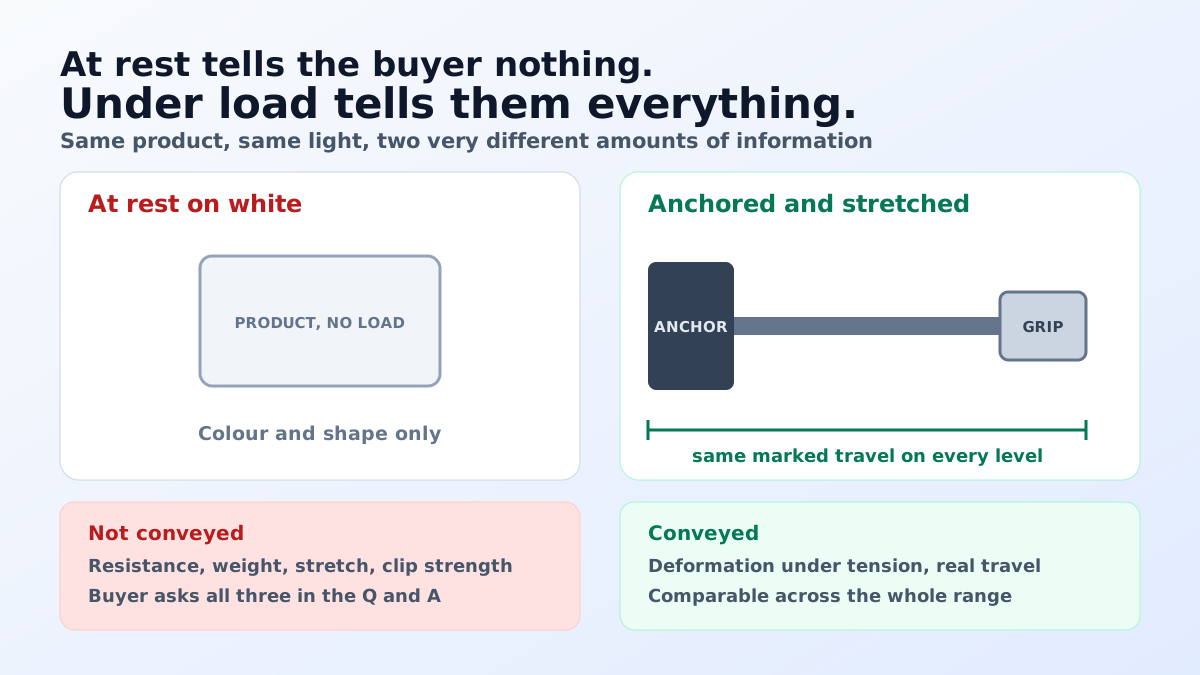
A white sweep is a measuring instrument for shape and colour. It strips away context deliberately, which is exactly right for a coffee mug, where shape and colour are most of the decision. For fitness gear the decision runs on properties that only reveal themselves through interaction, and stripping context strips the evidence. The object becomes a silhouette with a price, which is why so many listings in this category end up competing on price alone.
There is a second effect that sellers underestimate. On a search results page every product is rendered at the same pixel size, so a two kilogram dumbbell and a twenty kilogram dumbbell photographed identically look identical. Scale collapses. The buyer has to read the title to recover information the image should have carried, and a meaningful share of them will not bother. Restoring scale is therefore something sports equipment photography has to do deliberately, in the frame, rather than leaving it to the specification table.
Resistance and tension come first for anything elastic. Bands, expanders, cable attachments and suspension trainers all get bought by resistance level, and the number printed on the packaging means very little to a first-time buyer. What communicates is deformation: a band visibly thinned and straightened at load, an anchor point taking strain, a handle pulled to the end of its travel. That is a physical fact captured in a frame, not a claim.
Weight is second, and it is never visible directly. Mass shows up only in its consequences, which means fingers compressed around a grip, a mat dimpling under a kettlebell, a shoulder strap pulling taut, a rack bowing very slightly under a loaded bar. Photograph those consequences and the buyer feels the weight. Photograph the object alone and you have given them a number to imagine.
Third is durability, which in this category is mostly about joins. Nobody worries that the steel tube will fail, they worry about the weld at the base, the stitching where the strap meets the handle, the plastic clip that takes the whole load, and the coating that will chip on the first drop. Those are all small, and they all need their own frame at close range rather than being left as a detail somewhere in the full product shot.
Fourth is fit against the body and the room. A bench that does not fit under a bed, a bar that does not clear a doorway and a mat that is shorter than the person on it all generate returns that a single image could have prevented. Size questions are the most answerable of the four, and the most commonly ignored, because sellers assume the dimensions in the specification table are doing the job.
The core technique is simple: never photograph an elastic product at rest. Anchor one end to something visible in the frame, a door mount, a bar, a hand, and pull the other end to a fixed marked distance. Use exactly the same anchor and the same travel distance across every resistance level you sell, because a set of images that can be compared is worth far more than a set of individually attractive ones.
For rigid items the equivalent is a loaded frame. A pull-up bar with a person hanging from it, a bench with plates stacked on it, a rack holding a barbell: each one converts a claim about capacity into an observation. Keep the load realistic rather than heroic, because an obviously staged extreme reads as marketing while a plausible everyday load reads as evidence.
Shutter speed matters more here than in most product work, since anything under tension will move. Support the camera, keep the exposure short enough to freeze the band, and accept a higher sensitivity setting rather than a soft frame. Motion blur is one of the few faults nothing downstream can repair, and it appears far more often in sports equipment photography than in still-life categories.
A human body is the most reliable reference there is, because everyone carries an internal model of one. A hand around a grip settles the diameter question, a person seated on a bench settles the height, and a mat photographed with someone lying on it settles length in a way that no printed dimension does. Where a person is impractical, a doorway, a standard chair or a car boot all work because their sizes are broadly known.
Dimension overlays are the complement, not the substitute. They serve the buyer who has already measured the space and is checking a number, so keep them clean: two or three measurements, high contrast text, units spelled out, and nothing else on the frame. Marketplaces treat overlaid graphics differently depending on the slot, and the rules on what may appear on which image are laid out in the Amazon image requirements guide.
Close-up frames are the cheapest trust you can buy in this category. Fill the frame with the weld, the stitch line, the knurling on a bar, the density of the foam at a cut edge. Light them from the side rather than the front, because a raking light describes surface relief and a flat frontal light erases it. A buyer who can see the quality of a seam stops asking whether the product will last.
These frames also carry weight in the review cycle, since they are what a cautious buyer returns to before ordering. Images influence conversion more directly than any other element on a listing page, and the product image conversion statistics give a sense of how much of the decision is being carried visually rather than by the copy.
Most sellers in this category inherit supplier photographs: the object, on white, at one angle, at low resolution. Reshooting a full range of dumbbells is not realistic for a small catalogue, and this is where generation genuinely helps. A supplier frame can be restaged into a home gym or a studio floor with correct lighting and a real shadow, which recovers the context the original threw away. That restaging is the practical use of AI product photography in a category like this one.
The boundary is worth stating plainly. Generation can build an environment around your product, but it must not invent a specification, so a resistance figure, a load rating or a material has to come from your own data. Physical deformation under tension is also still best captured for real, because it is a fact about your product rather than a plausible arrangement of pixels. Marketplace-specific staging conventions for the main and secondary slots are covered on the Amazon product photography page.
Some properties simply do not fit in a static image. A band snapping back to length, a folding rack collapsing flat, a bar flexing and recovering, a mat unrolling and lying flat without curling: those are behaviours over time, and a still can only imply them. A few seconds of footage answers the question directly, and video slots sit right next to the images on most marketplaces where the buyer is already looking. Short clips can be built from existing product frames with the AI product video generator.
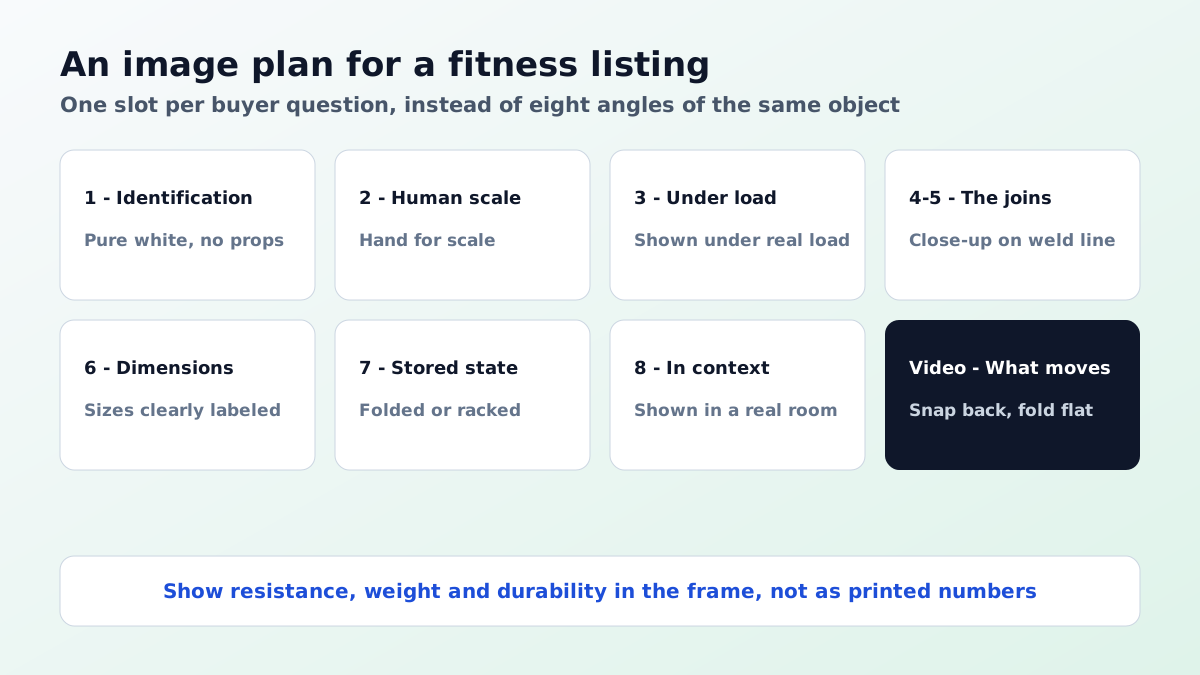
Put the whole thing together and the image plan for a fitness listing writes itself. One clean identification shot for the main slot, one in-use frame with a human for scale, one under load, two close-ups on the joins that fail, one dimension overlay, one packaging or storage state, and a clip for anything that moves. That sequence turns sports equipment photography from a catalogue exercise into an answer to the three questions the buyer was going to ask anyway.
Photograph the band or spring under load rather than at rest. A resistance band pulled to a marked length, with the anchor visible and the material visibly narrowed, shows the buyer what the stated resistance feels like far better than a coil of rubber on white. Shoot the same framing for every resistance level in the range so the set can be compared side by side.
Weight is read from its effects, not from the object. A hand gripping a dumbbell with the fingers compressed, a mat depressing under a kettlebell, a carry strap taut over a shoulder, a rack visibly loaded: those all signal mass. A dumbbell floating on a white background at the same size as every other listing in the results signals nothing at all.
On most marketplaces the main image has to be the product alone on a pure white background, so treat it as the identification shot and nothing more. The judgement images belong in the secondary slots, where in-use, scale and close-up detail frames are all allowed. Losing that distinction is why so many fitness listings waste six of their eight image slots on angles of the same object.
Use a dimension overlay against a familiar object and a room. A folded treadmill next to a doorway, a bench beside a standard chair, or a mat rolled against a wall gives a reliable reference. Abstract dimension callouts in centimetres help buyers who already measured their space, but they do not replace a picture of the item inside a normal room.
It can restage the product into a gym or home setting, add a realistic floor and lighting, and build the environment around a real photograph of your item. What it cannot do is invent a claim, so a resistance figure, a weight capacity or a material has to come from your own specification and not from the render. Physical tension and deformation are still best captured for real.
For anything that stretches, folds, resists or takes load, yes, because motion carries information no still frame can. A five second clip of a band returning to length, a rack folding flat or a bar flexing under weight answers the exact question buyers ask in the reviews. Short clips also tend to be the fastest way to reduce returns caused by mismatched expectations.
ListingRVA AI now works inside Claude. Connect your workspace and ask Claude to generate listing copy and publish product images to your store, without leaving your editor. See the Claude connector →
Comments
No comments yet, be the first.
Leave a comment