
Baby Product Photography: Showing Safety Without Claiming It
July 29, 2026 · 8 min read · by Aashirvad Kumar
Your credits refresh every month for as long as ListingRVA AI exists. No renewals, no annual increases, nothing to cancel.
Available on select plans. No renewals, ever.
July 29, 2026 · 8 min read · by Aashirvad Kumar
Your images are clean, the product is centred, the background is pure white, and the listing still loses to a competitor whose photos are visibly worse. That happens in this category more than any other, because baby product photography is not really being judged on how attractive the product looks. It is being judged on whether a parent can work out what the thing is made of, how it will behave after ten washes, and whether the person who made it was paying attention to the seams.
A parent buying a teether or a sleep sack is running a risk assessment, not a shopping trip. They cannot touch the fabric or smell the plastic, so they look for proxies, and every proxy they use is visual. Get those proxies into the frame and the same product sells at a higher price than a competitor who only photographed it politely from six angles.

Research on returns in soft goods keeps landing on the same three drivers: the material was not what the buyer expected, the size was not what they expected, and the finish quality was worse than the images suggested. All three are photographable. None of them are addressed by a hero shot on white, which is why the hero shot is necessary but almost never the image that closes the sale. The images that close it are the second, third and fourth frames, and most sellers spend the least effort on exactly those.
The useful mental model is that a parent is trying to reconstruct a physical experience from pixels. They want to know how the fabric collapses when you fold it, whether the zip pull is metal or painted plastic, whether the printed pattern sits on the surface or is woven into it, and whether the elastic is stitched down or just threaded through a channel. Every one of those is a five-second macro shot, and each removes a specific reason not to buy.
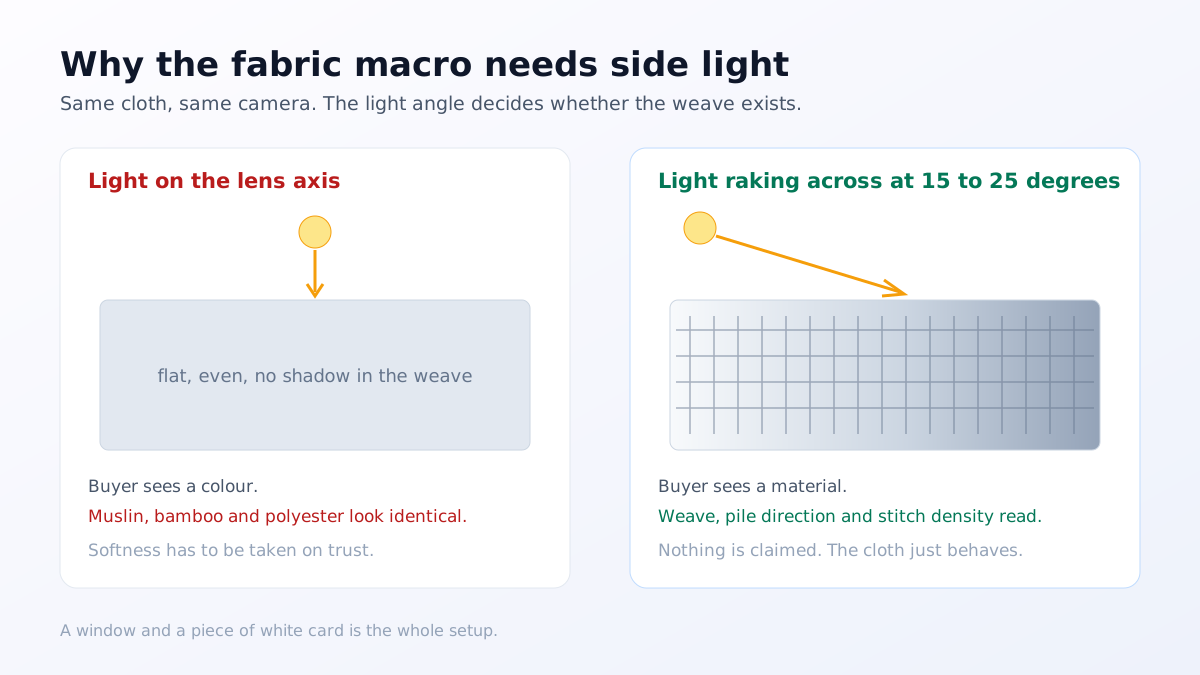
The single highest-value frame in baby product photography is a macro of the material at roughly the distance a hand would be. Fill the frame with fabric or moulded surface and light it from a low angle so the light rakes across the weave rather than hitting it flat. Raking light is what makes a pile stand up visually, what makes a knit read as a knit rather than a printed texture, and what shows whether a silicone surface is matte or slightly tacky. Flat frontal light destroys all of that in one shot.
The same frame is where a buyer decides whether a natural-fibre claim in your bullet points is credible. Cotton muslin, bamboo viscose and a polyester blend look almost identical under soft frontal light and look completely different under raking light, because they collapse differently and reflect differently. You are not asserting anything in this image, you are simply letting the material behave in front of a camera. Images carry more of the purchase decision than most sellers expect, and the product image conversion statistics put a number on how much of it they are doing.
Every baby product listing says machine washable. The claim is so universal that it carries no information, and parents have learned to discount it entirely. What they have not learned to discount is a photograph of the actual care label, shot square-on and legible at thumbnail scale, showing the wash temperature, the tumble dry symbol and the fibre composition. That one frame does more for a soft goods listing than another lifestyle scene, because it is verifiable rather than asserted.
The stronger version pairs it with a construction detail that explains why the product survives washing: an overlocked seam edge, a bar tack at a strap join, a bound edge rather than a raw hem. You do not need to caption these as durability features. A parent who has had a cheap sleep sack come apart at the shoulder recognises a bar tack on sight, and a parent who has not still reads the visible density of stitching as care.
Size confusion is expensive in this category because baby sizing is inconsistent between brands and because so many items are smaller than buyers picture. A hand holding the product is the most reliable reference available, since every buyer has an internal calibration for one. It works for bottles, bowls, teethers, socks and small toys. For anything larger, a labelled dimension frame with length, width and height in both centimetres and inches is the better tool, because a hand stops being a stable comparison once the object is bigger than it. Dimension frames also have to survive the platform's own resizing, and the rules for that are unusually strict on the marketplace covered in the Amazon image requirements guide.
This is where sellers get into trouble. Adding words like non-toxic, hypoallergenic or chemical-free as image text converts a marketing preference into a health claim, and image text is the weakest place to make one because it travels without any supporting evidence. Marketplaces treat unsubstantiated safety claims as a compliance matter, and the enforcement usually arrives as a suppressed listing rather than a warning.
The safe and more persuasive alternative is to photograph what genuinely exists. If the packaging carries a certification mark, shoot the packaging. If the product has a moulded date stamp or a woven label with a standard number on it, shoot that. You are documenting the object rather than describing it, which is both harder to challenge and more convincing, because a photograph of a real printed label reads as evidence in a way that a designed badge never does. The same discipline applies to the words in your listing text, and the ecommerce listing copy guide covers where those claims belong instead.
An in-use frame answers two questions at once: how big is this, and how is it meant to be used. That makes it valuable, but it also makes every detail load-bearing. An image showing a product in use is read as a demonstration of correct use, so a loose strap, an unsecured buckle or an unsupported head position is not a styling flaw, it is a signal that the seller is careless. Reviewers quote those images back at you.
Most sellers can get the scale benefit without the risk. A product shot on a real nursery surface, with a folded muslin and a soft window light, gives the room context that a white background cannot, and a separate hand-held frame handles scale. Restaging that way used to mean booking a set for a day, which is why so many small brands shipped white-background-only listings. That constraint is what AI product photography removed for this category first, since nursery scenes are mostly soft neutral surfaces rather than complicated hard-surface geometry.
Seven frames covers almost every objection a parent brings to this category, and the order matters as much as the content, because the second image is seen by a far smaller audience than the first and the sixth by a smaller one again. Put the material macro and the scale frame early, and leave the packaging flat lay last. Generating the room context and alternate colourways from a single clean hero is the part that used to consume the budget, which is why the per-image economics are worth checking on the image generation pricing page before you book a studio day.
None of this requires better equipment. Raking light is a window and a piece of card. A care label frame is thirty seconds. The reason strong baby product photography is rare is not cost, it is that most sellers photograph the product they are selling rather than the doubts the buyer is carrying, and in this category the doubts are unusually specific and unusually easy to photograph away.
Material and construction, before price and usually before the title. A parent scanning a grid of results is trying to work out what the thing is made of, whether it will survive washing, and whether the seams and fastenings look like they were finished properly. Photographs that answer those three questions in the first two images convert far better than photographs that only show the product from six polite angles.
You can show what is genuinely printed on the product or its packaging, photographed as it exists. What you should not do is design a badge that implies a certification you do not hold, or add wording like non-toxic or hypoallergenic as image text. Marketplaces treat unsubstantiated safety and health claims as a compliance issue, and image text is easier to challenge than a specification field because it carries no evidence with it.
Softness is not visible directly, it is inferred from how the material behaves. Photograph the fabric draped rather than flat, so the fold radius shows how easily it collapses. Use raking light across the surface so the pile or weave catches a highlight. A stiff fabric folds in wide angular planes and a soft one folds in tight rounded curves, and buyers read that difference without being told what to look for.
An adult hand is the most reliable one, because every buyer has calibrated their own. It works for bottles, teethers, bowls, socks and small toys. For larger items like a bassinet or a play mat, a labelled dimension image with the length, width and height in both centimetres and inches is more useful, since a hand no longer gives a stable comparison at that scale.
They help for scale and for showing intended use, but they carry constraints. Any image that shows a product in use is read as a demonstration of safe use, so the placement, the straps and the supervision context all have to be correct. Many sellers get most of the benefit with a lower risk by shooting the product on a nursery surface with a size reference instead.
You need at least one image that puts the product in a room, because parents are also judging whether it will fit and whether it will look acceptable in their home. Beyond that, extra lifestyle frames have diminishing returns compared with a macro of the fabric, a fastening close-up and a dimension image, which each answer a specific hesitation.
ListingRVA AI now works inside Claude. Connect your workspace and ask Claude to generate listing copy and publish product images to your store, without leaving your editor. See the Claude connector →
Comments
No comments yet, be the first.
Leave a comment