
Product Photography Cost Per SKU: Studio, Freelancer or AI
August 3, 2026 · 8 min read · by Aashirvad Kumar
Your credits refresh every month for as long as ListingRVA AI exists. No renewals, no annual increases, nothing to cancel.
Available on select plans. No renewals, ever.
August 3, 2026 · 8 min read · by Aashirvad Kumar
You asked three studios for a quote and got three numbers that are not comparable. One priced per image, one priced per half day, one priced per SKU with retouching listed separately and samples not mentioned at all. Working out your real product photography cost from those quotes is genuinely hard, and the reason is that the quoted number almost never describes what you will end up spending.
The useful unit is not the price of a shutter click. It is the total cash that leaves your account divided by the number of images you actually published, after the ones you rejected, after the courier both ways, and after the sample that came back with a scuff on it. Once you compute that number, the comparison between a studio, a freelancer and a generation tool changes shape, and it changes differently for a ten SKU brand than for a two hundred SKU catalogue.
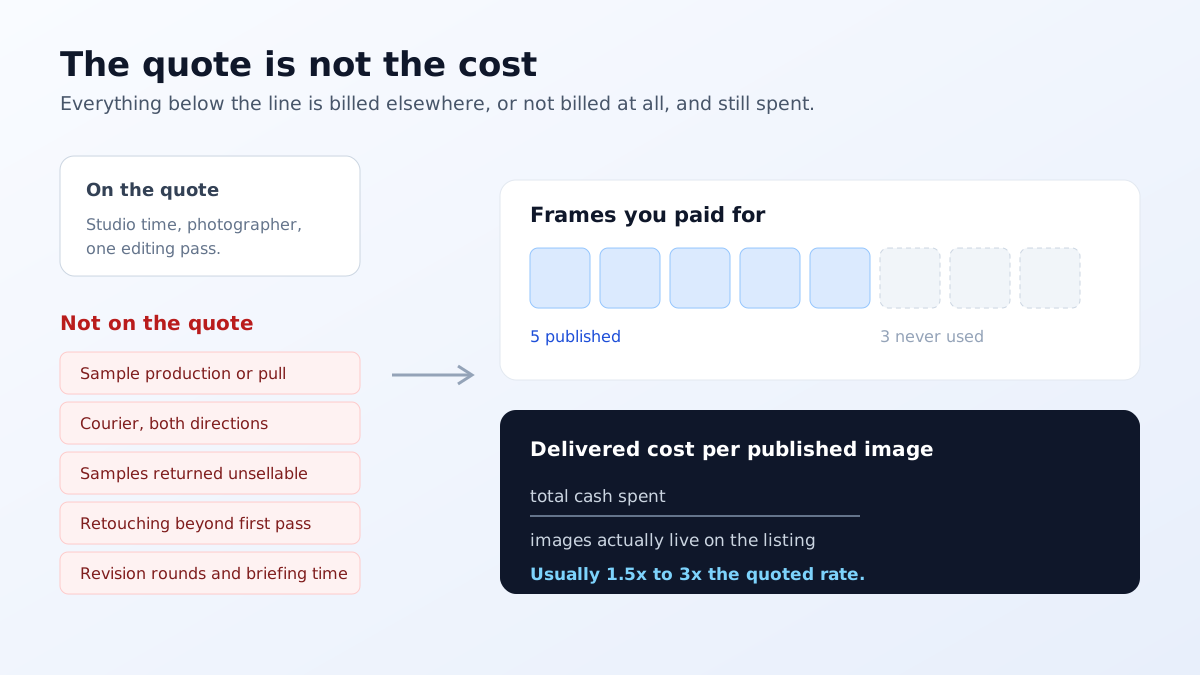
Most of the product photography cost you cannot see is hidden in scope boundaries. A photography quote covers the studio time, the photographer and usually a first pass of editing. Sitting outside it, in almost every case, are the things that decide whether the project was expensive: producing or pulling samples, courier in both directions, insurance or write-off on samples that come back unsellable, retouching billed per image beyond the included pass, revision rounds when the first set misses the brief, and the frames you paid for but never used.
That last one is the quiet killer. Shoots are normally scoped in generous image counts because more sounds safer, and then the listing publishes five of them. If you paid for nine and used five, your delivered cost per image is 80 percent higher than the number on the invoice line. Working out how many frames actually earn their place is the cheapest optimisation available, and the product image conversion statistics are a reasonable place to calibrate that.
A commercial studio is buying you three things that are hard to get elsewhere: controlled repeatable lighting, someone who has solved your material problem before, and accountability if it goes wrong. For a product where the material behaviour is the product itself, glassware, liquids, high-gloss lacquer, transparent packaging, that expertise is not a luxury. It is the difference between a photograph and a guess.
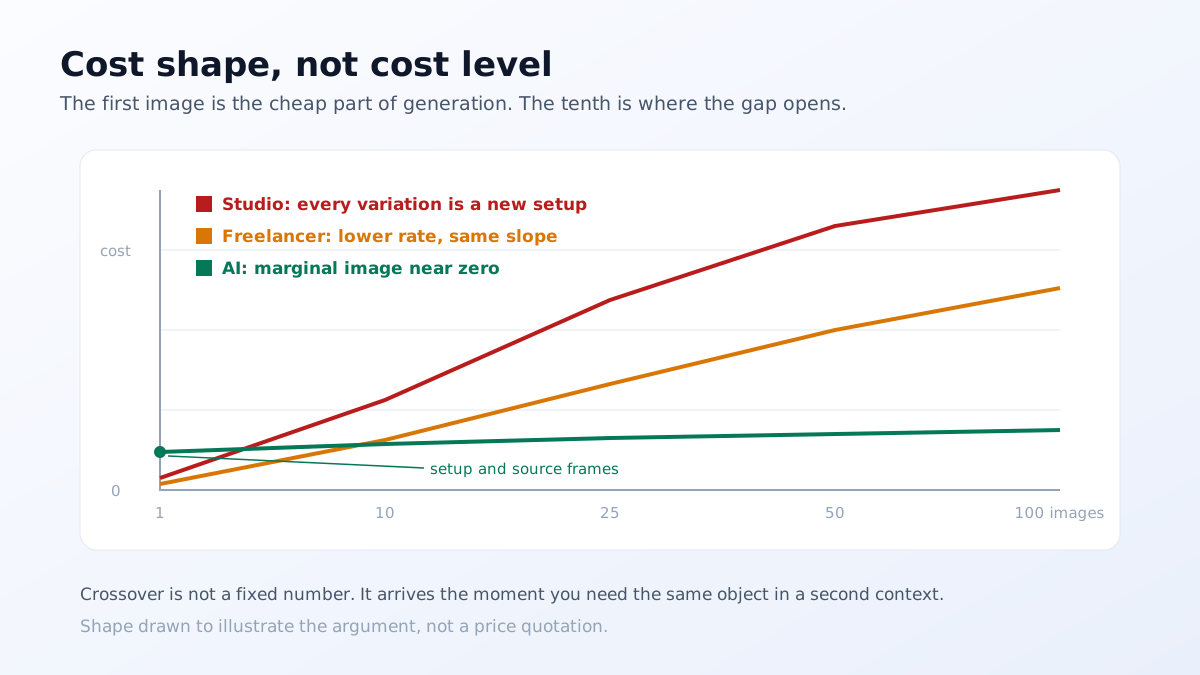
What the studio cannot fix is the marginal cost curve. The second background for the same object costs roughly what the first one did, because it is another setup, another styling pass and another retouch. That is fine when you need six images of one product and ruinous when you need six contexts each for eighty products. The product photography cost of variation, not of the first frame, is what breaks studio budgets on large catalogues.
Freelance rates sit well below studio rates in every market, and for straightforward catalogue work on white the output is often indistinguishable. What you are trading away is consistency across time. The same freelancer six months later has a different light modifier, a different room and a different retouching preset, and your catalogue gains a visible seam between the products shot in March and the ones shot in September. On a marketplace grid that inconsistency reads as two different brands.
The mitigation is boring and effective: write a one-page spec covering background value, camera height, the product's share of the frame, the shadow style, and the exact output size, and hand it to whoever shoots. Marketplaces then impose their own second layer of constraints on top, and the strictest of them are set out in the Amazon image requirements guide.
A current phone in soft window light, with a white card as fill and a fixed camera position, produces a usable catalogue frame. The cost is your time, and time is the thing that is genuinely scarce in a small business, so this option is cheap per image and expensive per hour. It makes sense when the catalogue is small, when products change often, and when nobody can wait three weeks for a studio slot. The honest accounting is that a founder spending a Saturday photographing forty SKUs has not saved the photography budget, they have converted it into unpaid labour at a bad hourly rate. That is still the right call when cash is the binding constraint and time is not, which describes most businesses in their first year. It stops being the right call the moment the same person is also the one answering support tickets and negotiating with suppliers, because the shoot is then displacing work that only they can do.
Generation flips the cost shape. The first usable image takes some iteration, and every image after it is close to free, which is the exact inverse of a studio. That makes it strongest precisely where studios are weakest: many contexts of the same object, seasonal refreshes, marketplace-specific crops, colourway variants, and A or B tests where you want four versions of a scene rather than one. It also collapses the calendar, which is a cost line nobody puts on a spreadsheet. A studio booking has a lead time, a shoot day, an edit turnaround and a revision cycle, and three weeks is a normal total even when nothing goes wrong. For a seasonal SKU those three weeks can be a meaningful share of the entire selling window.
The constraint is that output quality tracks input quality almost linearly. A sharp, correctly exposed source photograph of the product produces a convincing result, and a dark, motion-blurred one does not, because nothing can restore detail that was never captured. That is why the sensible pattern for most brands is not either-or: shoot clean source frames once, cheaply, then generate the variations. The per-image economics of that second step are worth checking against a studio quote on the image generation pricing page before committing to a shoot day.
Take your last completed shoot and add up every rupee or dollar that left the business because of it: the invoice, the retouching, both courier legs, the value of any sample written off, and a realistic figure for the hours your team spent briefing, reviewing and re-briefing. Then count the images currently live on your listings from that shoot. Divide. Most sellers running this calculation for the first time land somewhere between 1.5 and 3 times the number they thought they were paying.
Run the same arithmetic on the alternative before you switch. Generation has its own overhead: someone has to shoot clean source frames, write the prompts or fill the fields, review the outputs and reject the ones with distorted text or wrong proportions. It is much smaller overhead, but it is not zero, and a fair comparison counts it. The honest version of the trade-off is set out in the AI versus traditional photography comparison rather than in either side's marketing.
The trap worth naming is treating this as a quality decision when it is an allocation decision. Nobody has an unlimited image budget, so every extra frame of one product is a frame not shot for another. Spending three studio days on your top ten sellers and generating everything else usually beats spreading a thin freelance budget evenly across the whole catalogue, because the top ten carry most of the revenue and the tail mainly needs to be clear and consistent rather than beautiful. Getting the tail listed at all is the higher-value move, and the same logic drives multi-marketplace listing automation for the copy side of the same problem.
One last thing worth measuring rather than assuming: the cost of not having the image. A SKU sitting unpublished because it is waiting for photography earns nothing at all, and for a seasonal product it may never earn anything. Against that, the difference between a good image and an excellent one is a rounding error, and any product photography cost model that ignores time to publish is measuring the wrong thing.
Quoted rates vary enormously by market and by how much styling is involved. A plain white background catalogue frame is usually the cheapest line on any quote, and styled lifestyle or model frames are several times that. The number that matters is not the quoted rate but the delivered rate, which is the total invoice plus sample logistics divided by the images you actually published after reshoots.
Because the quote covers the shutter and almost nothing else. Sample production, courier both ways, samples that come back unsellable, retouching charged separately, revision rounds, and the images you shot but never published all sit outside it. On small runs those items routinely exceed the photography line itself, which is why a low per-image quote on a ten SKU shoot can still be the expensive option.
Per image, by a wide margin, because the marginal cost of the second variation is close to zero while a studio charges for it at the same rate as the first. The saving is largest where you need many contexts of the same object: colourways, seasonal backgrounds, marketplace-specific crops. It is smallest where the product has to be worn, assembled, or demonstrated in motion.
When the object itself has never been photographed, when material behaviour is the product (drape, transparency, liquid, gloss), when a human has to interact with it convincingly, and when you are shooting a hero image that will carry a brand campaign. A studio day that produces clean, well lit source frames also makes every downstream AI variation better, so the two are not really competitors.
Most marketplaces show between six and nine image slots and buyers rarely go past the fifth. A practical target is one clean hero, two detail frames, one scale or dimension frame, one in-context frame and one packaging or what-is-included frame. Budgeting for nine when five carry the decision is one of the most common ways sellers overspend.
Cheap is not the risk, uninformative is. An image set that fails to show material, scale and finish costs conversion and drives returns regardless of what it cost to produce. A phone photograph in good soft light with a sensible shot list frequently outperforms an expensive shoot that only produced six polite angles on white.
ListingRVA AI now works inside Claude. Connect your workspace and ask Claude to generate listing copy and publish product images to your store, without leaving your editor. See the Claude connector →
Comments
No comments yet, be the first.
Leave a comment