
AI Listing Optimization: What It Automates and What It Cannot
July 24, 2026 · 8 min read · by Aashirvad Kumar
Your credits refresh every month for as long as ListingRVA AI exists. No renewals, no annual increases, nothing to cancel.
Available on select plans. No renewals, ever.
July 24, 2026 · 8 min read · by Aashirvad Kumar
The marketing around AI listing optimization tends to imply that a model reads your product and produces a listing that ranks. The reality is narrower and more useful than that. AI is genuinely excellent at one half of the job and structurally incapable of the other half, and knowing which is which is the difference between a tool that saves you days and a tool that quietly makes your catalogue worse.
We build one of these tools, so treat the second half of this article as the part worth reading.
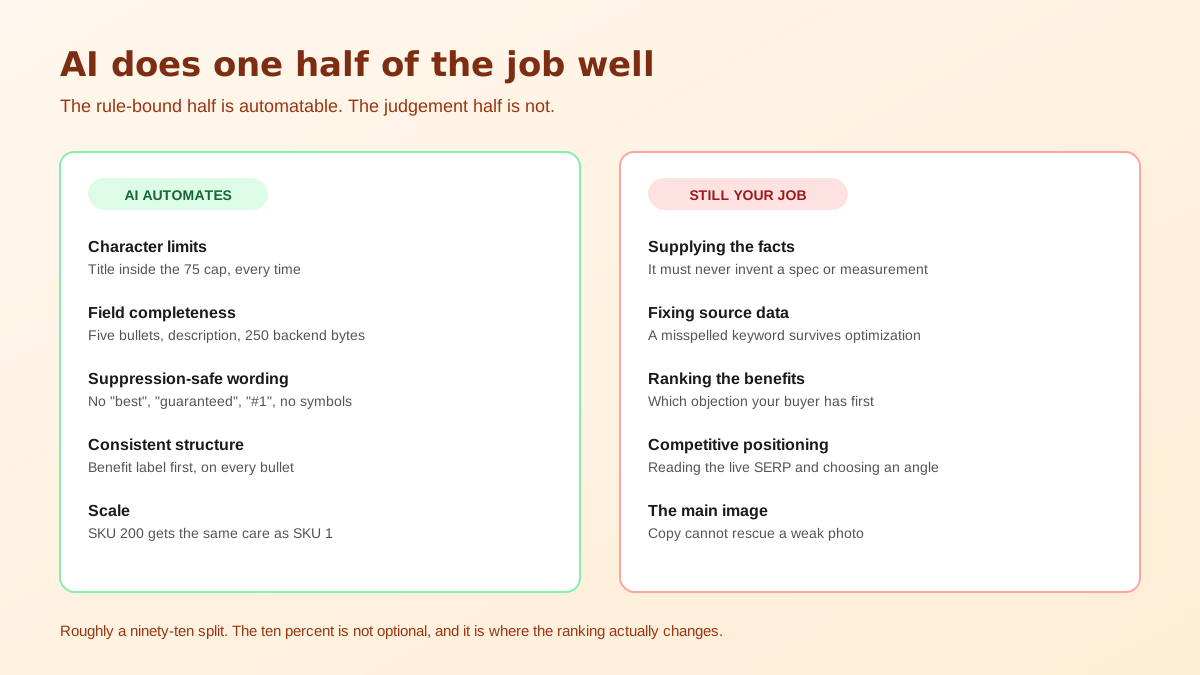
All of these are rule-bound tasks. They have a correct answer, the answer does not change per product, and humans get worse at them as the catalogue grows.
If a measurement, material or certification is not in your source data, it must not appear in the output. This sounds like a limitation and is actually the most important safety property a listing tool can have. An invented dimension is a returns problem. An invented certification is a compliance problem. Our own generation rules forbid inventing specs or on-image text for exactly this reason, and if your tool is producing claims you never supplied, that is a defect worth switching over. The product image conversion statistics put a number on how much of that decision the images are really carrying.
The stakes scale with category. An invented water-resistance rating on a watch, a dosage on a supplement, an age grading on a baby product or a fabric composition on a garment are not merely inaccurate, they are the kind of inaccurate that produces returns, angry reviews and in regulated categories a takedown. A tool that will happily fill a gap with a plausible-sounding number is more dangerous in those categories than no tool at all.
The practical consequence: thin product data produces thin listings. AI does not compensate for a product record with no materials, no dimensions and no use case. It formats what you have.
We ran a real listing through our own tool and it preserved the seller's spelling of a keyword, which was wrong, because the model cannot tell an intentional brand spelling from a typo. The listing came out dramatically better and still missed the highest-volume keyword in its category. Amazon draws those lines in different places, which the Amazon image requirements guide spells out field by field.
This generalises to everything upstream. Wrong category, wrong dimensions, missing variant data: all of it survives optimization intact. Audit the product record first.
A model can produce five well-formed, benefit-led bullets. Ranking them is a different task. Which objection does your buyer have first? That answer lives in your reviews, your returns reasons and your customer questions, not in the product description. It also moves by category: for a baby product the lead is almost always safety, for jewellery it is the occasion, for a watch it is water resistance or strap comfort, and for apparel it is fit and sizing. A model will write all four competently and has no way to know which one your buyer stalls on. Reordering the top two bullets by hand is the single highest-value minute you can spend on an AI-generated listing, because on mobile those two are often all a shopper sees.
Deciding to compete on durability because the top three listings all compete on price is strategy. It requires looking at a live search results page and making a judgement about positioning. A tool working from your product data alone has no view of that.
Copy fixes indexing and supports conversion. The main image wins the click in the first place, and no amount of well-written text compensates for a photo that looks worse than the listing above it. This is why we treat the copy and the AI product photography as one job rather than two.
In practice the split is roughly ninety-ten, and the ten percent is not optional:
The failure mode we see most often with AI listing optimization is sellers treating the output as finished and bulk-publishing it. The second most common is the opposite: rewriting every AI sentence by hand and losing the entire time saving. The tool is a very fast first draft with the compliance already handled.
Output quality tracks input quality almost linearly, so the highest-leverage work happens before you press generate:
This is where most sellers lose the thread. They rewrite a listing, watch the rank for three days, see nothing, and conclude AI listing optimization does not work. The measurement problem is that copy changes move different metrics on different timescales.
Two practical rules. First, do not change the copy and the main image in the same week on a listing you are trying to measure, or you will not know which one moved the number. On a listing you simply want fixed, change both at once and stop worrying about attribution. Second, leave it alone for at least two to four weeks before judging. Re-optimizing a listing every few days resets the clock and teaches you nothing.
Used this way, AI listing optimization is not a shortcut to ranking. It is a way to make sure every listing in your catalogue meets a decent standard, so that your remaining effort goes into the ten listings where judgement actually changes the outcome. If you want it applied across a catalogue in one pass, that is what our Amazon listing optimization software does, with you approving each change. If you would rather work through the fields manually, the 10-step listing optimization playbook covers each one in order.
50 free credits, no credit card. Title, bullets, description and images from one product photo.
Start free →The rule-bound work: keeping the title inside the character cap, using all five bullet slots, front-loading a benefit label, avoiding suppression-triggering words, filling all 250 bytes of backend search terms without duplicating the title, and applying the same standard to every SKU. These are the tasks humans do inconsistently by listing forty.
A well-built tool should refuse to. If a measurement, material or certification is not in your source data, it should not appear in the output, because an invented spec is a returns problem and a compliance problem at once. If your tool produces claims you did not supply, that is a serious defect.
No, and that is deliberate. AI cannot tell an intentional brand spelling from a typo, so it preserves your wording. If your data spells a keyword wrong, the optimized listing carries the same mistake and you lose that traffic. Audit the product record before you optimize.
Not reliably. It can produce five well-formed benefit-led bullets, but ranking them requires knowing which objection your buyer has first, which comes from reviews, returns and customer questions. Reordering the top two by hand is the highest-value minute you can spend.
No. Optimized copy fixes indexing and helps conversion, but rank is driven by sales velocity, and velocity depends heavily on the main image and price. Excellent copy with a weak main image still underperforms. Copy is necessary and not sufficient.
ListingRVA AI now works inside Claude. Connect your workspace and ask Claude to generate listing copy and publish product images to your store, without leaving your editor. See the Claude connector →


Comments
No comments yet, be the first.
Leave a comment