
Amazon COSMO and Alexa for Shopping: What They Read in Your Listing
July 24, 2026 · 8 min read · by Aashirvad Kumar
Your credits refresh every month for as long as ListingRVA AI exists. No renewals, no annual increases, nothing to cancel.
Available on select plans. No renewals, ever.
July 24, 2026 · 8 min read · by Aashirvad Kumar
For a decade, optimizing an Amazon listing meant getting the right strings into the right fields. The shopper typed words, Amazon matched those words against your listing, and the seller who covered more variations won. Amazon AI listing optimization is a different exercise, because the layer sitting in front of retrieval now tries to work out what the shopper meant rather than what they typed.
Two things drive this: Amazon COSMO, the commonsense knowledge layer for inferring intent, and the conversational surface, which is now Alexa for Shopping after Rufus was retired. A caveat worth stating plainly: Amazon does not publish the internals of either, so what follows is about what the shift means for how you write, not a claim about how the ranking code works.
Keyword search asked "does this listing contain the shopper's words?". A semantic layer asks "is this product a good answer to what this shopper is trying to do?". Those two questions reward completely different writing.
Under the first question, repeating a phrase in the title, the bullets and the backend was rational. Under the second, repetition adds almost nothing, because the system already understands that two phrasings mean the same thing. What it cannot infer is context you never stated. If the argument needs evidence, the product image conversion statistics cover what actually shifts buyer behaviour.
Material, size, colour, capacity, compatibility, quantity, age range. These are machine-readable without any interpretation at all, which makes them the cleanest signal you can hand an AI layer. They are also the most neglected part of the average listing. Sellers will spend an hour agonising over a title and leave half the attribute fields blank, which is exactly backwards for Amazon COSMO and the AI layer generally.
If you do one thing after reading this, fill in your attributes.
Semantic retrieval can connect a situation to a product, but only if the product page gives it something to connect to. "Rattan storage basket" describes what the thing is. "Rattan storage basket for shelf, gift hamper and wedding decor" describes what it is for, and the second version can be surfaced for situations the first never matches.
This is why "for", "who", and "when" phrasing has become disproportionately valuable. You are not stuffing keywords, you are supplying context that would otherwise have to be guessed.
A conversational assistant answering "will this fit a standard shelf?" has to find that answer somewhere. If your listing states the dimensions in a bullet in plain language, it can. If the dimension exists only inside an A+ image, it is far less likely to.
Look at your customer questions and reviews, take the five things people repeatedly ask, and make sure each one is answered as text in a bullet or the description. That is both good conversion copy and good machine-readable copy, which is a rare case of the two goals pointing the same way.
This is the trap in image-heavy listings. A+ modules and infographics are excellent for shoppers, but text baked into an image is not as reliably available to a machine reader as text in your structured fields and bullets. Amazon has also been removing A+ alt text, which closed the old workaround.
The rule that follows is simple: anything a machine needs to know must exist as real text somewhere in the listing fields. Put it in the image too if it helps the shopper, but never only in the image.
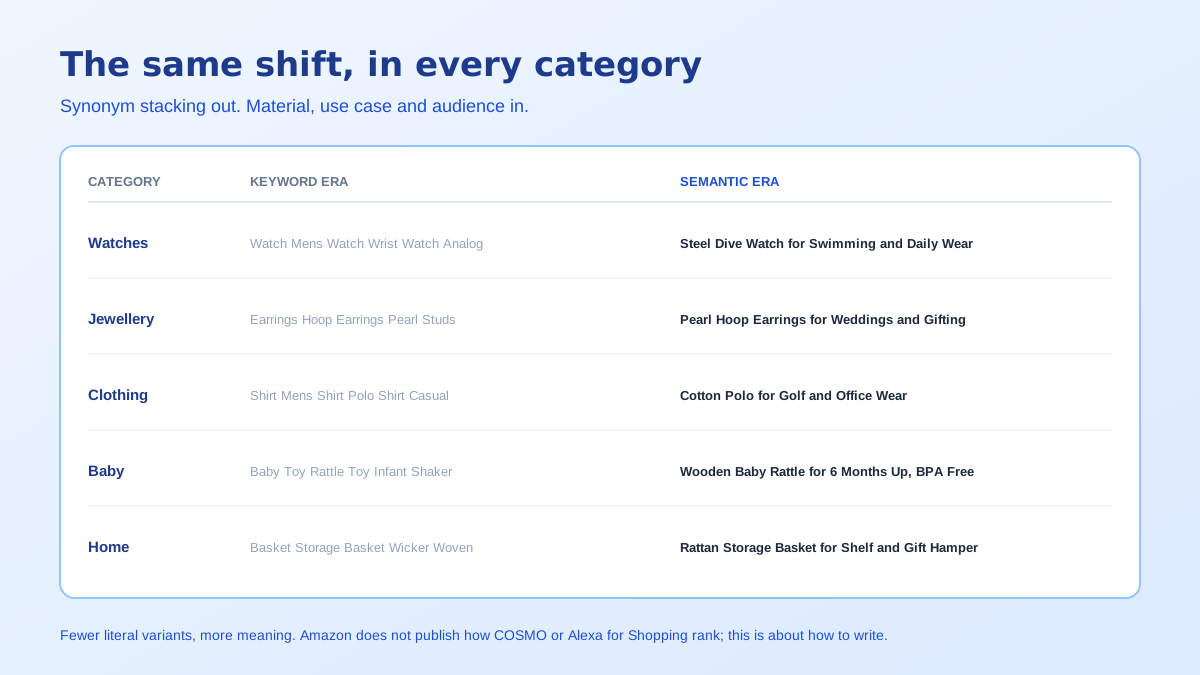
This is not a home decor quirk. The same rewrite applies wherever you sell, and seeing it across categories makes the pattern obvious:
In every case the right-hand version covers fewer literal strings and carries far more meaning. It states the material, the format and a concrete situation, and a semantic layer can connect those situations to shopper intents that never use the category noun at all. The baby example is the clearest: "for 6 months up" and "BPA free" answer the two questions every parent actually has, and neither is a keyword the old approach would have prioritised.
The rewritten versions are shorter, which feels wrong if you learned Amazon SEO in 2018. That instinct is the thing to unlearn. The synonyms were only ever there to satisfy a matching algorithm, and a system that understands "wicker" and "rattan" are related does not need you to spend title characters proving it. We saw exactly this play out in our before and after teardown of a real listing.
The practical test for Amazon AI listing optimization: read your title out loud as if answering a shopper who asked what the product is and who it is for. If it reads like a list of search terms rather than an answer, you are still writing for the old system.
Note that the second version still contains the important literal keywords. This is not an argument for vague, lifestyle-flavoured copy. Amazon AI listing optimization means being specific about meaning, not being loose about terms.
It would be a mistake to read any of this as "keywords are dead". Your listing still has to be indexed for the terms buyers actually type, backend search terms still matter, and the main image still wins the click before any of this is relevant. Amazon AI listing optimization is additive to the fundamentals, not a replacement for them.
Sales velocity also still drives rank. A listing perfectly written for a semantic layer with no conversions will not outrank a mediocre listing that sells. Nothing about the AI shift changes that arithmetic.
None of this requires new tooling. It requires the listing to be complete, which loops back to the least glamorous finding in all of our testing: most listings underperform because fields are empty, not because the writing is bad. Our free Amazon listing quality checker will show you which sections are thin, and our Amazon listing optimization software fills them across a catalogue in one pass. For the field-by-field manual version, use the 10-step listing optimization playbook, and pair it with AI product photography so the image half is not left behind.
50 free credits, no credit card. Title, bullets, description and images from one product photo.
Start free →Amazon COSMO is Amazon's commonsense knowledge layer for product retrieval. Rather than matching the shopper's words against the words in your listing, it tries to infer intent, so a search framed around a situation can surface products whose listings never contain that exact phrase. In practice it rewards listings that state context and use case explicitly.
No. Rufus has been retired and Alexa for Shopping is the conversational surface to optimize for now. The practical implication is similar either way: an assistant answers a shopper's question by summarising product information, so listings that answer questions plainly get represented more accurately.
Keyword stuffing optimises for string matching. Semantic retrieval optimises for meaning, so repeating a phrase adds little while stating who a product is for and what problem it solves adds a lot. Cramming synonyms into the title now mostly wastes the character budget.
Yes, and they are the most under-used field. Structured attributes such as material, size, colour, capacity and compatibility are machine-readable without interpretation, which makes them the cleanest signal you can give an AI layer. Sellers routinely leave half of them blank while spending hours on the title.
It helps shoppers and feeds Amazon's understanding of your product, but image-based A+ text is not as reliably readable as your structured fields and bullets. Anything a machine needs to know should exist as real text in the listing fields, not only inside an image.
ListingRVA AI now works inside Claude. Connect your workspace and ask Claude to generate listing copy and publish product images to your store, without leaving your editor. See the Claude connector →


Comments
No comments yet, be the first.
Leave a comment