
Amazon COSMO: Why Your A+ Content Trains the AI Instead of Ranking You
Jul 9, 2026 · 9 min read · by Aashirvad Kumar
Your credits refresh every month for as long as ListingRVA AI exists. No renewals, no annual increases, nothing to cancel.
Available on select plans. No renewals, ever.
Jul 9, 2026 · 9 min read · by Aashirvad Kumar
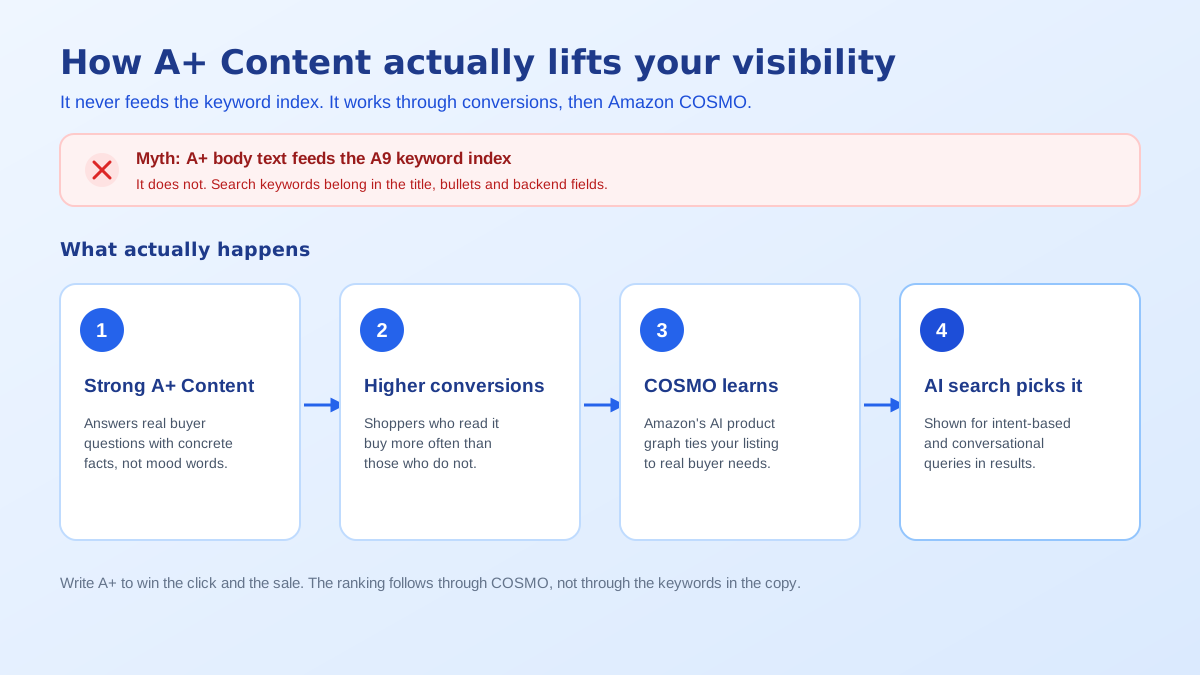
Here is a result that frustrates a lot of sellers. You rewrite your A+ Content, pack it with your best keywords, publish, and wait for a ranking bump that never comes. It is tempting to blame the copy. The real explanation is more useful: A+ body text does not feed Amazon's keyword index at all. Agencies have split-tested this for years and landed on the same answer every time.
That does not mean A+ is pointless. It means A+ works through a completely different door, one that has only grown more important with Amazon COSMO, the AI layer now shaping what shows up in search. Understand the mechanism and you stop writing A+ for a robot that is not reading it, and start writing the A+ that actually moves your business.
This guide explains what Amazon COSMO is, why A+ text does not rank you, the real loop through which A+ influences visibility, and what to write instead.
Amazon described COSMO in its own 2024 SIGMOD research paper. It is a common-sense product knowledge graph, a giant map of how products, needs and situations relate. The public version spans millions of nodes and tens of millions of connections across many product categories. In plain terms, COSMO tries to understand not just the words a shopper typed, but what they are actually trying to accomplish. The product image conversion statistics put a number on how much of that decision the images are really carrying.
Crucially, COSMO does not replace the older A9 engine. It sits on top of it. A9 still handles keyword matching, sales velocity, click-through rate and conversion rate. COSMO adds an intent-matching layer above that, and it increasingly decides which listings get surfaced for long-tail and conversational queries, the kind that shoppers now type into the AI assistant. Feed quality decides whether the product appears at all, which the product data for AI search covers.
A9 indexes specific fields: your title, your five Amazon bullet points, your backend search terms and your structured attributes. Your A+ Content body copy is not one of those fields. Amazon has never confirmed that A+ text is indexed for keyword ranking, and every serious split test points the same way. On top of that, the alt-text field that sellers once stuffed with keywords is now generated by Amazon's own AI, so that loophole is closed too.
So if you have been treating the A+ description as extra keyword real estate, that effort is quietly wasted. The keywords belong in the fields A9 actually reads. The A+ area is for something else entirely. Getting the keywords into the fields A9 reads, not the A+ text, is what dedicated amazon SEO software handles across the whole listing.
This is worth sitting with, because it inverts a habit most sellers picked up years ago. The instinct to cram every field with search terms made sense when more keywords meant more visibility. In the A+ area that instinct backfires twice: it does nothing for ranking, and the dense, robotic copy it produces actively lowers conversion by burying the answers a real shopper is scanning for. The fix is not to write less, it is to write for a person. Amazon draws those lines in different places, which the Amazon image requirements guide spells out field by field.
Here is the mechanism that matters. Good A+ Content raises your conversion rate, because it answers questions, builds confidence and reduces hesitation. Conversion rate is a real ranking and recommendation signal. When more of your visitors buy, A9 rewards you with better placement, and COSMO reads those purchases as evidence that your product genuinely satisfies the intent behind the search.
In other words, A+ does not talk to the algorithm with words. It talks to the algorithm with behavior. Every shopper your A+ converts is a data point telling Amazon COSMO, "for this need, this product delivered." Do that consistently and the AI starts surfacing you for the intents your buyers keep confirming. That is the loop: better A+, more conversions, stronger intent signals, more visibility, more conversions.
The strategy flips from "stuff the AI" to "convince the human, and let the human train the AI." Practically:
Two sellers list a similar yoga mat. Seller A writes an A+ page crammed with phrases like "best yoga mat, premium non-slip yoga mat, yoga mat for home gym," hoping the words will rank. Seller B writes an A+ page that answers questions: "6mm thick for joint support on hard floors, 183cm long for tall practitioners, textured surface that stays grippy when your hands sweat, wipes clean in seconds." Neither page changes A9 keyword ranking, because A+ text is not indexed. But Seller B converts far more visitors, because every doubt a shopper had is resolved right there on the page.
Now watch the loop turn. Seller B's higher conversion rate feeds both A9 and COSMO. Amazon starts surfacing Seller B for intent queries like "thick yoga mat for bad knees," because the purchases confirm the product fits that need. Seller A, meanwhile, keeps wondering why a page full of keywords went nowhere. The words were never the mechanism. The conversions were, and Seller A never generated them.
The mental shift is small but total. You are not optimizing text for a crawler, you are earning behavior from a human, and that behavior is exactly what teaches Amazon COSMO to trust and surface you. Once you see A+ that way, every design decision gets easier, because you are always asking the same question: does this module help a real person decide to buy.
If the whole point of A+ is conversion, then the design and clarity of your modules is the real lever, not keyword density. This is where an AI Product Photography and content tool pays off. Instead of a slow design queue, you generate a complete, persuasive A+ page from your product details in minutes.
Write A+ for the shopper, measure the conversion lift, and let those wins teach Amazon COSMO to send you more of the right traffic. That is a loop you control.
Generate a complete, compliant, conversion-focused A+ page from one product photo. 50 free credits, no credit card.
Start free →Not directly. A+ body text does not feed Amazon's A9 keyword index, which sellers have confirmed through years of split tests. A+ influences ranking indirectly by lifting conversion rate, and conversion is a genuine ranking and recommendation signal.
COSMO is Amazon's common-sense product knowledge graph, described in its 2024 SIGMOD paper. It sits on top of the A9 engine and adds an intent-matching layer that connects what shoppers search to what they actually want, increasingly deciding which products surface for long-tail and conversational queries.
Because A+ raises conversion rate, and conversions are exactly the behavioral signal COSMO and A9 reward. Well-written A+ that answers real buyer questions turns visits into sales, and those sales feed the systems that decide your future visibility.
Write for the shopper, not the index. State concrete facts, answer the questions buyers actually ask, and use a complete, varied module set. That produces the conversions and intent signals COSMO is built from.
No. COSMO sits on top of A9. A9 still handles keyword match, sales velocity, click-through and conversion signals, while COSMO adds an intent layer that gates which listings appear for conversational and long-tail searches.
ListingRVA AI now works inside Claude. Connect your workspace and ask Claude to generate listing copy and publish product images to your store, without leaving your editor. See the Claude connector →


Comments
No comments yet, be the first.
Leave a comment