
Amazon Listing Optimization Service vs Freelancer vs AI: The Real Cost
July 23, 2026 · 9 min read · by Aashirvad Kumar
Your credits refresh every month for as long as ListingRVA AI exists. No renewals, no annual increases, nothing to cancel.
Available on select plans. No renewals, ever.
July 23, 2026 · 9 min read · by Aashirvad Kumar
Every seller with more than a handful of SKUs eventually asks the same question: do I pay an Amazon listing optimization service, hire a freelancer, or run software and do it myself. The advice online is almost always written by one of the three, which is not much use when you are trying to compare them honestly.
So here are the actual published numbers, the cost per SKU at catalogue scale, and the cases where each option genuinely wins. We sell software, so read the agency section with that in mind. We have tried to make it the section an agency would agree with.
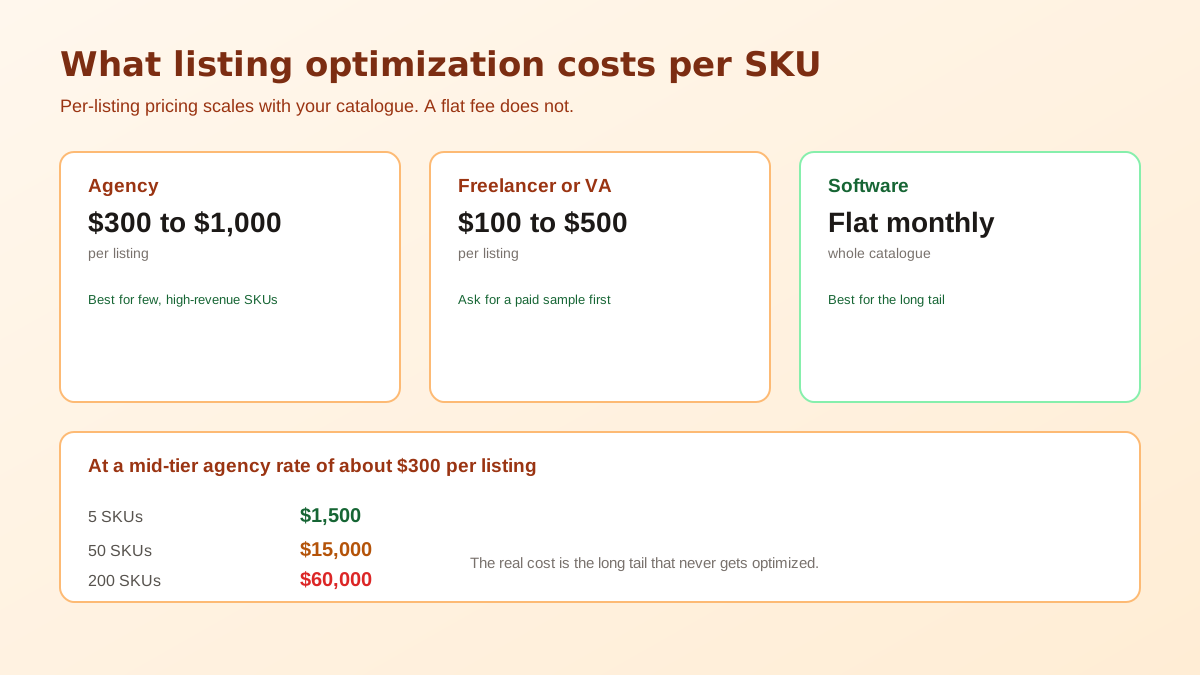
Pricing guides published this year are reasonably consistent, and the ranges are wide because the scope varies from copy only to copy plus images plus A+ content.
Category drives the quote as much as scope does. A home decor item with one variant is quick work. A garment with size and colour variants, a supplement with compliance-sensitive claims, a baby product with age grading, or a watch with technical specifications all need more research and carry more risk, and quotes reflect that. If you sell in a regulated category, expect to sit at the upper end of every range above. If the argument needs evidence, the product image conversion statistics cover what actually shifts buyer behaviour.
Published ranges put freelance listing work at roughly 100 to 500 dollars per listing. This is the widest-variance option by far. You are buying an individual, not a process, so the same 200 dollars can buy genuinely good copy or keyword soup depending entirely on who you hired.
Amazon software suites are priced per month for the whole account rather than per listing. Helium10 sits around 99 to 129 dollars a month on its Platinum tier, ZonGuru starts near 49 dollars a month, and dedicated listing copy tools start around 99. Our own plans run from free to 199 a month. The defining difference is not the number, it is that the number does not move when your catalogue grows. Where the term list is the bottleneck, the free Amazon keyword generator produces one you can paste into the backend.
Per-listing pricing is fine for one product and brutal for fifty. Take a mid-tier agency rate of about 300 dollars per listing:
That last point is the one worth sitting with. The real cost of per-listing pricing is not the invoice, it is the listings you never fix. Most catalogues have a head of ten products that get attention and a tail of ninety that were written once and never touched. The tail is where the easy wins usually are, precisely because nobody has looked at it. The equivalent rules on the other marketplace are collected in the Amazon image requirements guide, and they are not identical.
Flat-priced software inverts that. The marginal cost of optimizing SKU number 87 is zero, so the tail gets the same treatment as the head. That is the actual argument for software, and it is an argument about coverage rather than quality.
This is the part most software companies skip, so let us be specific. A good Amazon listing optimization service is not just writing.
If you have five listings doing serious revenue in a regulated or technical category, an agency retainer is a reasonable purchase and software is not a substitute for it.
A rough decision rule that holds up in practice:
That last combination is what most growing sellers actually land on, and it is a perfectly sensible answer. The mistake is paying agency rates to fix the long tail, or expecting software to make a strategic category call for you.
Most bad outcomes come from a vague scope rather than a bad provider. Whether you are briefing an Amazon listing optimization service, a freelancer, or evaluating software, these five questions surface the difference between a 200 dollar quote and a 900 dollar one.
Run the same five questions past any tool you are considering. A good Amazon listing optimization service and a good piece of software should both be able to answer all five without hedging, and the answers are what you are actually comparing, not the headline number.
Score your listing first. A large share of what sellers pay to have rewritten was not the weak part. If your title is already strong and your images are the problem, a copy-focused Amazon listing optimization service will bill you for the wrong fix. Our free Amazon listing quality checker scores title, bullets and description without a login, so you can walk into any of these conversations knowing which section is actually failing.
If the answer is that most of the catalogue needs work, our Amazon listing optimization software rewrites and scores every section for one flat price, and you approve each change before it publishes. If you want the manual framework instead, the 10-step listing optimization playbook walks through each field, and AI product photography handles the image half that copy alone cannot fix.
50 free credits, no credit card. Title, bullets, description and images from one product photo.
Start free →Published 2026 pricing guides put freelancers at roughly 100 to 500 dollars per listing and specialist agencies at 300 to 1,000 dollars or more, depending on whether images and A+ content are included. Ongoing retainers commonly run 1,500 to 10,000 dollars a month, with a basic engagement covering 1 to 20 listings at around 1,500 to 3,000 a month.
It can be, for a small number of high-revenue listings in a complex or regulated category, or when you also need PPC, account health and brand strategy handled. The economics stop working on a large catalogue, because per-listing pricing scales linearly while the work becomes increasingly repetitive.
For the repeatable part, yes. Titles, bullets, descriptions, backend keywords and images follow rules that software applies consistently across a catalogue for a flat fee. What it does not replace is category judgement, competitive strategy, and knowing which benefit deserves the top bullet for your buyer.
Flat-priced software, by a wide margin. Fifty SKUs at a mid-tier agency rate of about 300 dollars each is roughly 15,000 dollars, while catalogue-wide software sits in the tens of dollars a month. The trade-off is that you review the output yourself rather than handing the judgement to someone else.
A freelancer or VA is the middle option: cheaper than an agency, more accountable than nothing, but quality varies enormously and you still pay per listing. The common failure is keyword-stuffed copy that reads badly to buyers. Ask for a paid sample on one of your own SKUs before committing a catalogue.
ListingRVA AI now works inside Claude. Connect your workspace and ask Claude to generate listing copy and publish product images to your store, without leaving your editor. See the Claude connector →


Comments
No comments yet, be the first.
Leave a comment