
Etsy vs Shopify for Handmade: Where Should You Actually List?
August 16, 2026 · 8 min read · by Aashirvad Kumar
Your credits refresh every month for as long as ListingRVA AI exists. No renewals, no annual increases, nothing to cancel.
Available on select plans. No renewals, ever.
August 16, 2026 · 8 min read · by Aashirvad Kumar
You have thirty finished pieces, a phone full of process shots, and a decision you keep putting off. Every craft forum has an opinion, and the Etsy vs Shopify for handmade argument almost always collapses into two slogans: Etsy takes all your money, or Shopify gets no traffic. Both are half true. Which half matters to you depends on facts about your business that nobody asks about before handing over the advice.
The useful starting point is that these are not two versions of the same product. Etsy is a marketplace that comes with a shopper population and a search engine attached. Shopify is software that builds you a shop with nobody standing in it. Choosing between them is really choosing whether to rent demand or to build it, and that question has a different correct answer at different stages of a craft business.
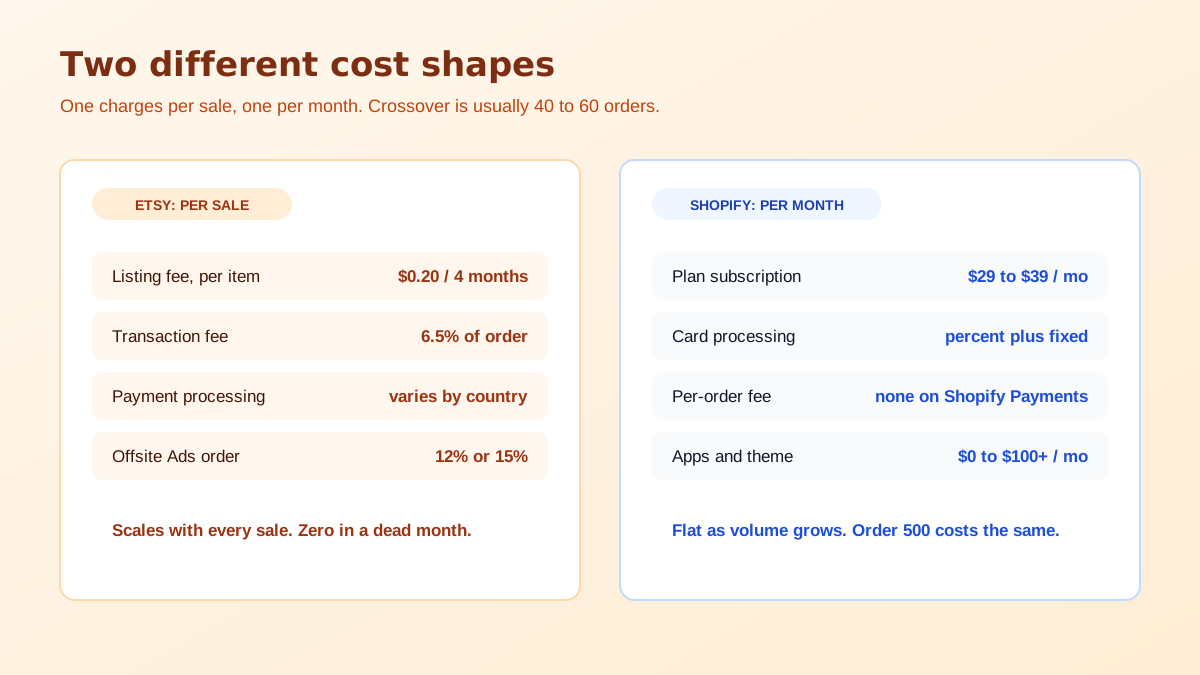
Etsy's cost is a stack, and sellers usually count only the first layer of it. There is a listing fee of twenty cents per item, charged again every four months when a listing auto-renews and again each time the item sells and is relisted. On top of that sits a transaction fee of 6.5 percent, applied to the item price and to the shipping you charge, not to the item alone. Payment processing is separate and varies by country. If an order is attributed to Offsite Ads, another 12 or 15 percent comes off, and shops above the annual revenue threshold cannot opt out of that programme.
Shopify's stack is shaped differently rather than being smaller. The entry plan sits in the range of roughly thirty to forty dollars a month depending on whether you pay annually or monthly, and card processing takes a percentage plus a fixed amount per transaction. There is no per-listing charge and no commission on the order itself when you use Shopify Payments, so the marginal cost of your hundredth sale is close to the marginal cost of your first. Apps are where budgets quietly disappear: reviews, email, a subscription tool and a paid theme can double the monthly figure without anyone noticing.
The crossover between the two is arithmetic rather than ideology. Take your average order value, multiply it by monthly orders, and treat somewhere between nine and eleven percent as the realistic all-in Etsy cost once processing is folded in. Compare that number against a subscription plus card fees. At typical handmade price points the fixed cost usually starts winning somewhere around forty to sixty orders a month, though the honest version of that sum has a condition attached that most spreadsheets leave out. The same fixed-versus-variable comparison plays out at much larger scale elsewhere, and the Amazon versus Shopify cost breakdown runs the identical maths with bigger numbers.
Fees are the argument people enjoy having. Traffic is the one that decides the outcome. Etsy delivers a shopper who is already in a buying frame of mind and already typing something like handmade ceramic mug, and you did nothing to earn that visit except exist in the index with a listing good enough to be shown. A new Shopify store starts at zero visitors and stays there until you build a channel: Instagram, Pinterest, email, craft markets, wholesale, press, paid ads. None of those are free either. They are paid in hours rather than in percentages, which is a different bill, not a smaller one.
That is exactly why a fee comparison on its own misleads people into moving too early. If you shift a hundred Etsy orders a month onto your own domain, the real question is not whether you keep the 6.5 percent. It is how many of those hundred orders follow you across. For a maker with a genuine audience, most of them do. For a maker whose sales all arrive through generic marketplace searches, close to none of them do, and the saved commission has bought a beautifully designed shop that nobody visits.
Etsy search itself rewards signals you control and signals you mostly do not. Relevance comes from your title, tags and attributes matching the phrase a buyer typed. Quality comes from recent conversion rate, review score, dispatch speed and how your price sits against comparable listings for that query. New listings get a short visibility window in which to prove themselves, which explains the familiar pattern of a spike followed by silence. The part you can influence is the wording, and an AI Etsy listing generator is a fast way to produce title and tag variants that match how buyers actually phrase things.
Etsy's handmade policy is stricter than most new sellers assume and looser than the folklore claims. You must have made the item or designed it. Working with a production partner is permitted, but the partner has to be declared in your shop, and the claim that you designed the piece needs to be defensible: picking a colourway from a supplier's existing catalogue product is not design in the sense the policy means. Reselling finished goods is the shortest route to a shop that gets closed rather than warned.
Shopify imposes no equivalent gate, and that cuts in both directions. You can sell anything you like, which also means nothing about your store signals to a first-time visitor that the work is genuinely made by hand. On the marketplace the category itself acts as the trust badge. On your own domain you build that trust from nothing, using process photography, a maker biography, honest material detail and realistic dispatch times. The work does not vanish when you leave the marketplace, it moves out of compliance and into content.
Handmade listings live or die on whether the images convey texture and scale, because the buyer is paying a premium specifically for evidence of a human hand. Glaze crazing, tool marks, stitch density, wood grain and the slight asymmetry that proves nothing was moulded: those details are the product as much as the object is. A flat catalogue shot on pure white erases precisely the things that justify the price, which is why working through a full product photography angles checklist matters more for craft than for mass-produced goods.
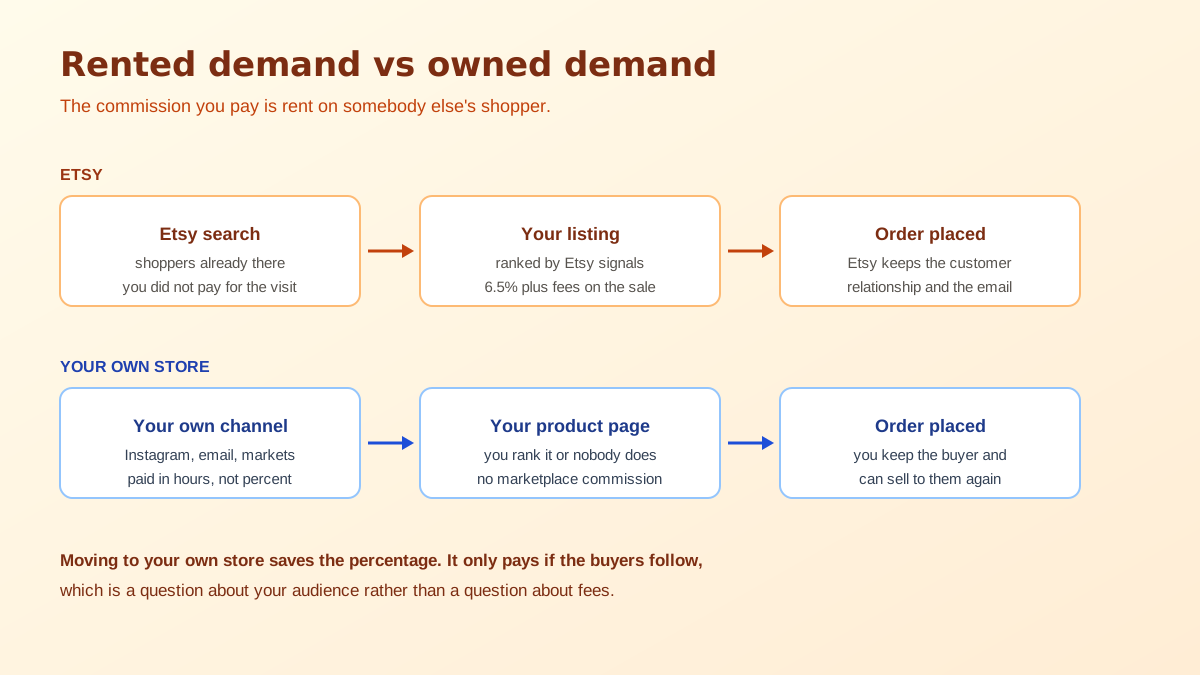
The conclusion most experienced makers reach is not either or. Etsy becomes the discovery channel and the testing ground that tells you which designs have demand at which price. The owned store becomes the place where repeat buyers, custom commissions, wholesale enquiries and email subscribers land, which are the customers you already paid a commission to acquire once. The roles are distinct even though the catalogue overlaps, and you stop paying a percentage on relationships you built yourself.
The obvious objection is workload. Two inventories, two sets of crops, two descriptions written to different house styles, and a stock count that has to stay honest in both places. In practice the copy is the expensive half, because a marketplace listing rewards conversational, keyword-dense phrasing while your own product page has to carry weight in Google as well. Keeping one source of truth and generating the platform-specific version from it is what makes running both survivable, which is the whole idea behind multi-marketplace listing automation.
You do not need a strategy document, you need four numbers and one honest answer. Pull them from your own sales history rather than from a comparison video, because the deciding factor is your traffic mix and nobody else can see it.
If the last two numbers are close to zero, stay on the marketplace and spend the effort on listings instead of on infrastructure. If they are healthy, open the store and treat the marketplace as an acquisition channel you are happy to pay for. The answer to Etsy vs Shopify for handmade changes as those numbers change, so it is worth revisiting every quarter rather than treating it as a one-time identity choice. Whichever way you go, the copy has to do double duty for shoppers and for search, and the principles in this ecommerce listing copy guide apply to both platforms without modification.
Neither is cheaper in the abstract, because one charges per sale and the other charges per month. Etsy costs a listing fee, a percentage of each order and payment processing, so the bill rises with volume and is close to zero when you sell nothing. Shopify costs a fixed subscription whether you sell nothing or five hundred items. Low volume favours Etsy, steady volume favours the subscription.
Work it out rather than guessing. Multiply your average order value by your monthly orders, apply roughly nine to eleven percent as the all-in Etsy cost once processing is included, and compare that against the plan price plus card fees. At typical handmade prices the fixed cost usually wins somewhere in the range of forty to sixty orders a month, but only if those orders would still happen without Etsy search.
Yes, and most established makers do. Etsy works as the discovery channel and the place new designs get tested against real demand. The owned store takes repeat buyers, custom commissions, wholesale enquiries and email subscribers, which are the customers you already paid to acquire once. The two are not competitors so much as different stages of the same relationship.
It does, provided you designed the item and you declare the partner in your shop settings. What is not allowed is reselling finished goods you had no hand in designing, including catalogue products with a colour swapped. That distinction is enforced, and shops that get it wrong tend to be closed rather than warned, so it is worth being conservative about what counts as your own design.
Some will, and the proportion tells you whether the move makes sense. If most of your orders come from buyers who found you through a maker community, an Instagram audience or word of mouth, they will follow. If your orders come from generic Etsy searches for the product type, they belong to the marketplace and not to you, and saving the commission simply buys an empty shop.
The same source photographs work for both, but the running order changes. Etsy shows a square thumbnail in a dense grid, so the first frame has to read at small size against competing listings. Your own product page has room to build a sequence: hero, scale reference, detail, in-use, packaging. Shoot once, large and square, then crop for each context rather than reshooting.
ListingRVA AI now works inside Claude. Connect your workspace and ask Claude to generate listing copy and publish product images to your store, without leaving your editor. See the Claude connector →
Comments
No comments yet, be the first.
Leave a comment