
Etsy Tags Not Working? What Happens After You Edit a Listing
August 12, 2026 · 8 min read · by Aashirvad Kumar
Your credits refresh every month for as long as ListingRVA AI exists. No renewals, no annual increases, nothing to cancel.
Available on select plans. No renewals, ever.
August 12, 2026 · 8 min read · by Aashirvad Kumar
You spent an evening rewriting all thirteen tags on your best listing, using better phrases than the ones you had thrown in when you first published it. Four days later the views are down by half and the listing that used to bring in a sale every couple of days has gone quiet. The obvious conclusion is that Etsy punished you for editing, and the obvious response is to change them back, or change them again. Etsy tags not working after a rewrite is almost never a penalty, and treating it as one is what turns a two week dip into a two month one.
What actually happened is more mundane and more fixable. Tags are the connection between a listing and a set of queries, and rewriting them replaces the entire set of connections in one move, including the ones that were working invisibly. Almost every report of etsy tags not working turns out to describe that swap rather than a fault in the tags themselves.
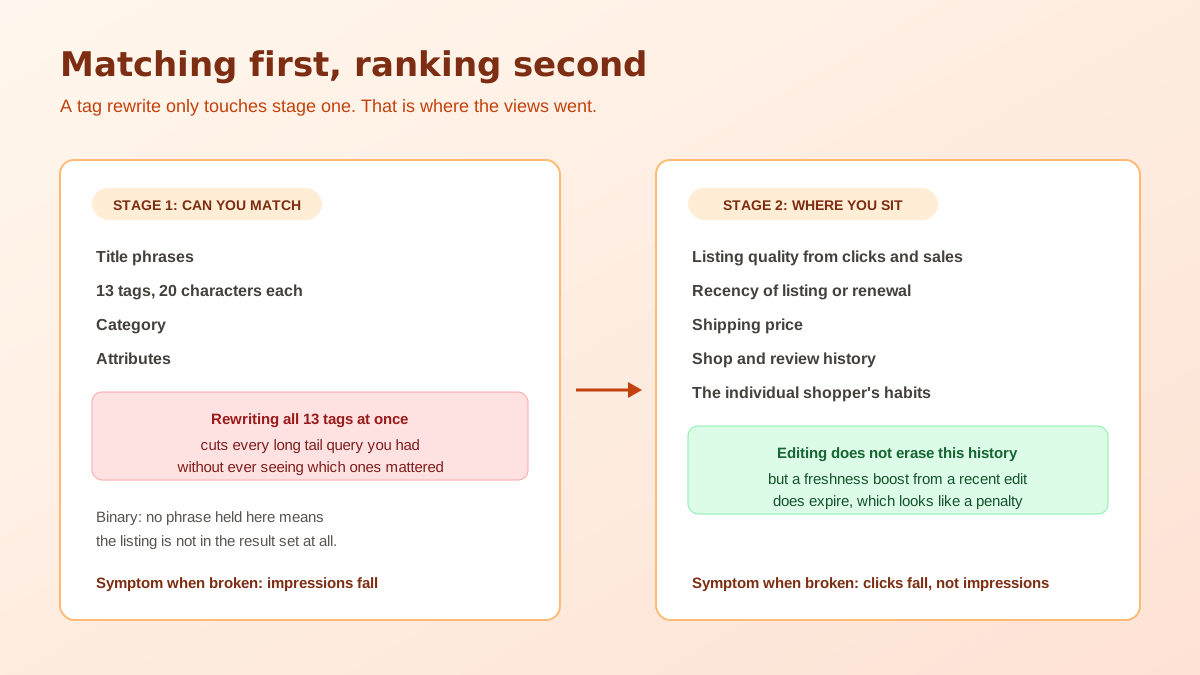
The first decision is matching. A shopper types a phrase, and Etsy assembles the set of listings that could plausibly answer it using the title, the tags, the category and the attributes. If none of those hold the phrase, the listing is not in the set and nothing else about it matters. This stage is binary and it is entirely under your control, because every input to it is a field you filled in.
The second decision is ordering, and it uses signals you influence rather than set. How often shoppers click and buy when your listing is shown, how complete and well reviewed the shop is, the shipping cost, whether the listing is new or recently renewed, and the individual shopper's own history. That accumulated performance is what people mean by listing quality, and Etsy's stated position is that editing a listing does not throw it away.
Both halves of the explanation live in the matching stage. Your old tags almost certainly matched queries you never consciously targeted, because thirteen slots of loosely chosen phrases combine into a surprisingly wide net, and long tail queries are where most small shops earn their traffic. When you replaced all thirteen, you cut every one of those connections at once, including the two or three that were quietly producing the sales.
The second half is timing. Renewing or editing a listing gives it a short lived freshness advantage, so a listing edited a month ago may have been sitting slightly higher than its natural position and is now settling back at the same moment your new tags took effect. Two changes landed together, you attribute the fall to the one you performed deliberately, and the data cannot separate them because you changed thirteen things at once. This is also why the advice to renew listings constantly is so persistent and so misleading: renewal buys a brief lift that decays, so a shop that renews weekly is repeatedly paying for the same temporary effect and reading it as evidence that renewal works.
Open your search analytics and compare the two periods on impressions first, not on views. If impressions have collapsed, the listing has stopped matching queries and the cause is in the tags, title, category or attributes. If impressions are steady and views have fallen, matching is fine and the problem is that shoppers are seeing you and choosing something else, which is a thumbnail, price or review problem and no amount of tag editing will address it. Splitting the two before you touch anything saves most of the wasted work, because the seller who rewrites tags in response to a click rate problem gets a worse listing and no recovery.
Then look at which specific queries you used to appear for and which ones you appear for now. Most sellers discover at this point that the old tag they considered clumsy, something like gift for new home, was the single largest source of impressions on the listing, and that it did not survive the rewrite. That is the practical shape of etsy tags not working: not a broken feature but a removed connection nobody was monitoring. Keep a note of the top five query phrases per listing before any rewrite and this diagnosis takes two minutes instead of two weeks of guessing.
The character ceiling explains a lot of the clumsiness. Each tag can hold twenty characters including spaces, which is enough for a two or three word phrase and not enough for the natural long phrases buyers actually type. Fighting that limit by using single broad words is the standard mistake, because a one word tag enters you into the most competitive query on the platform where an established shop with thousands of sales will always outrank you. Being matched to a query you cannot place on is worth nothing, and it is worse than nothing when it displaces a narrow phrase you could have owned outright. The right instinct is to write the phrase a buyer would type when they already know what they want, then trim it to fit twenty characters rather than broadening it.
Overlap with the fields that already match is the other silent waste. Your category and attributes participate in matching on their own, so a tag that restates the category you already selected, or a colour you already set as an attribute, is spending one of thirteen slots on a match you had for free. Read the attributes back before writing tags and the number of genuinely available slots usually turns out to be smaller than thirteen. Treat those remaining slots as the only real estate you have, and spend each one on a phrase that nothing else on the listing covers: an occasion, a recipient, a room, a material, a style name that buyers use and catalogues do not.
Title agreement is the last piece. A phrase carried by both the title and a tag is a stronger match than one carried by a tag alone, so the two or three phrases you most want should appear in both places, while the remaining slots cover ground the title has no room for. Getting that split right is fiddly by hand across a large shop, which is what the Etsy title and tag generator exists to shortcut.
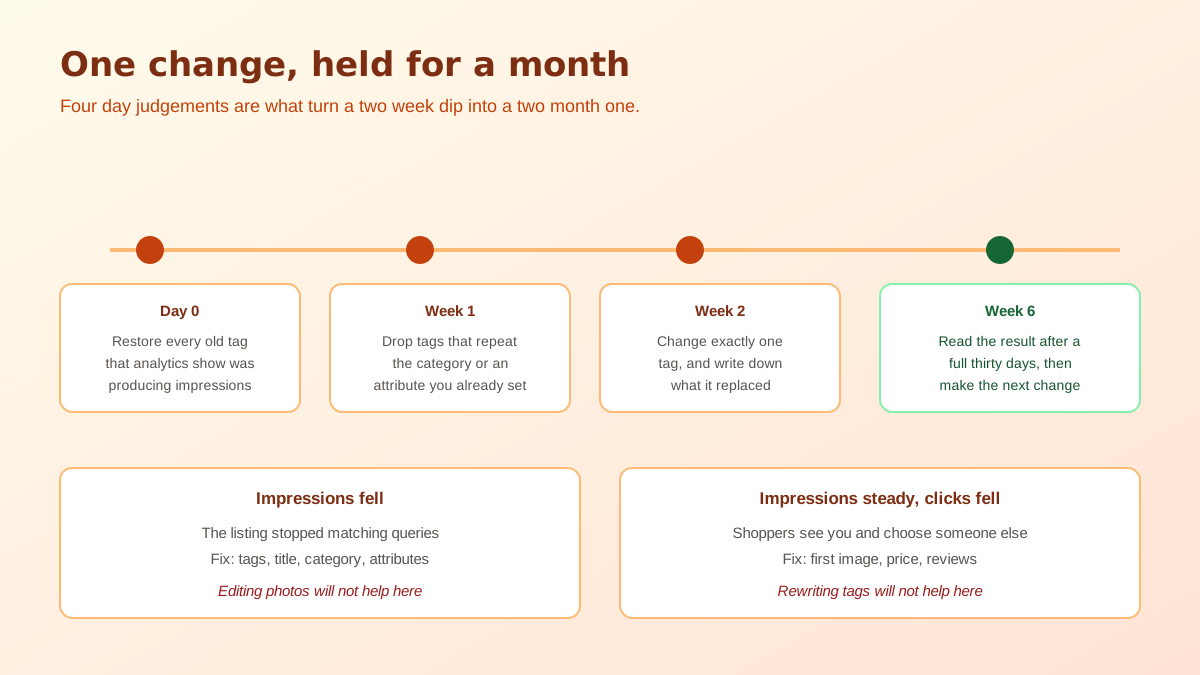
The discipline in that list is worth more than any individual tag choice. Most shops rewrite their tags repeatedly, four days apart, with no record of what the previous set was, which makes every change untestable and guarantees the shop learns nothing across a year of effort. That habit, rather than the platform, is what keeps a seller stuck with etsy tags not working for months at a time. One change, held for a month, with the old version written down, teaches you something permanent about your own category.
It is also worth being honest about which half of the funnel your problem sits in, because the fix is completely different on each side. Steady impressions with falling clicks means shoppers are seeing you in a grid of thumbnails and picking a competitor, and in a marketplace where the first image is roughly a square inch on a phone, that is a photography verdict rather than a keyword one. The differences that decide it are set out in the guide to Etsy product photography tips, and the scale of the effect is quantified in the product image conversion statistics.
For most handmade and small batch sellers the constraint on fixing that is time rather than taste, since reshooting a fifty item catalogue for consistency is a week of work that does not feel like it is producing anything. Generating a consistent set of lifestyle and detail images from the photos you already own removes that week, which is the practical argument for AI product photography in a shop this size. Just check the disclosure rules first, since Etsy treats some routine edits as AI assistance, as covered in the note on Etsy background removal disclosure.
Etsy's stated position is that editing does not wipe out the performance history a listing has accumulated. What editing does change is the set of queries the listing can match, so a rewrite that removes the phrases you were quietly ranking for produces a fall in views that feels like a penalty but is really a disconnection.
At least thirty days. Anything shorter is dominated by noise, by day of week effects and by whatever recency boost the edit itself triggered. Judging a change after four days is the single most common reason sellers reverse a good decision, then reverse it again, and end up with tags that have been rewritten five times and tested zero times.
Twenty, including spaces, across thirteen tag slots. That ceiling is what forces the real discipline, because a useful long phrase rarely fits and a single broad word wastes a slot on a query you cannot win. Two or three word phrases that a buyer would actually type are the shape that fits the constraint.
They should agree with the title rather than copy it word for word. A phrase that appears in both the title and a tag is a stronger signal for that phrase, so the two or three phrases you most want to win deserve to appear in both places. Spending all thirteen slots re-stating the title, however, leaves nothing covering the phrases the title cannot fit.
Spending two of thirteen slots on near identical phrases is rarely the best use of them. The two variants compete for essentially the same shopper, and the slot would do more work carrying a different phrase entirely, such as a material, an occasion or a recipient that no other tag currently covers.
Two ordinary causes explain most of it. A recency boost from a recent renewal or edit expired, returning the listing to its normal position, or seasonal demand for your phrases fell. Neither is a fault in the listing, and both are visible in search analytics as a change in impressions rather than a change in click rate.
ListingRVA AI now works inside Claude. Connect your workspace and ask Claude to generate listing copy and publish product images to your store, without leaving your editor. See the Claude connector →
Comments
No comments yet, be the first.
Leave a comment