
Amazon Competitor Listing Analysis: Read It, Do Not Copy It
August 11, 2026 · 8 min read · by Aashirvad Kumar
Your credits refresh every month for as long as ListingRVA AI exists. No renewals, no annual increases, nothing to cancel.
Available on select plans. No renewals, ever.
August 11, 2026 · 8 min read · by Aashirvad Kumar
You open the listing sitting above yours, you read the title, you rewrite your own title to match its structure, and nothing happens. Three weeks later you copy their bullet order too, and still nothing. The listing you were copying ranks because it has been selling since 2019 and carries 4,100 reviews, and no amount of word order transfers either of those things. Most amazon competitor listing analysis fails at exactly this point, by treating a visible feature as the cause of an invisible advantage.
A competitor page is evidence, not a template. Read correctly it tells you what buyers in this category ask, what objections the market has, and which of those the incumbent has failed to answer. Read as a template it produces a listing that looks like theirs and performs like yours did before.
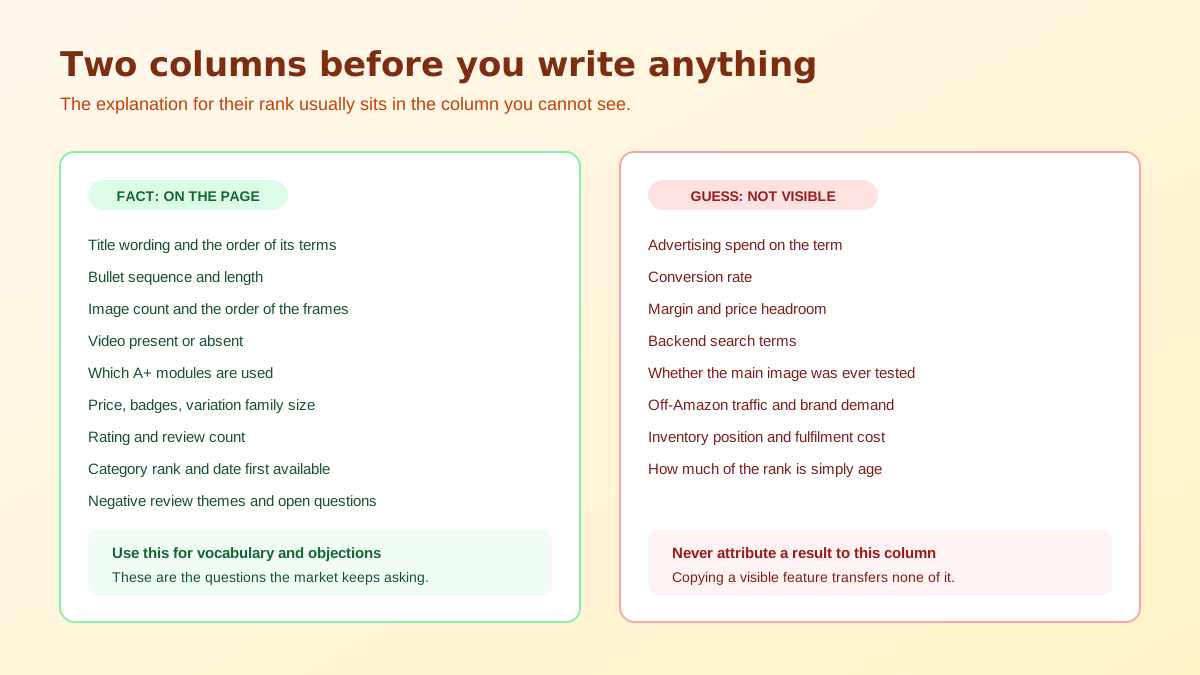
Write two columns before you write anything else. On the left, what the page actually shows: the title wording and the order of terms within it, bullet sequence, the number and order of images, whether there is a video, which A+ modules are used, price, badges, variation family size, rating, review count, category rank and the date first available. All of that is fact.
On the right, what you are inferring: their advertising spend, their conversion rate, their margin, their backend search terms, whether that main image was chosen deliberately or has been there since launch. None of that is visible, and the right hand column is usually where the real explanation for their position lives. Keeping the two apart is the whole discipline, because a good amazon competitor listing analysis mostly protects you from confidently learning the wrong lesson. Every seller who has rebuilt a title to match a competitor and watched nothing change has paid for that lesson once already.
Category bestseller lists are the wrong input. A brand can top a category on demand for its own name, which tells you nothing about how to win a generic term. Instead take your three highest value search terms, run each one, and record the listings occupying the top organic positions for each. If the same listing appears for all three, that is a genuine competitor. If a bestseller appears for none of them, it is not competing with you at all.
This also gives you the vocabulary layer for free. Look at which nouns and qualifiers repeat across every listing ranking for a term, because that repetition is the market telling you what shoppers actually type. Adopt the vocabulary and reject the structure. If you want to build that word list systematically rather than by eye, a free Amazon keyword generator will do the mechanical part faster than a spreadsheet will.
Start with the image sequence, because it is the most deliberate part of any competent listing and the most revealing. Each frame after the main image is a hypothesis about an objection. Frame two is usually scale or what is in the box, frame three is often the feature that gets asked about most, and a size chart or comparison frame near the end tells you the seller has been dealing with returns. Read the sequence as a list of the questions this market asks.
Then read the negative reviews, which is where the actual content brief lives. One and two star reviews name objections in the buyer's own words, and the useful ones are the recurring complaints about fit, sizing, durability or compatibility. If your product genuinely does not have that flaw and their page never addresses it, you have found differentiation you can prove rather than a claim you can assert. Answer it in an image, not only in a bullet, because most shoppers never read to bullet four.
The customer questions section is the same material from a different angle. Questions that get asked repeatedly are questions the listing failed to answer, and every one of them is a candidate for your own bullets or A+ modules. A competitor with a large question backlog about compatibility has told you exactly what to put in your third image.
Then check the review count against the date first available. Two thousand reviews accumulated over six years is a different competitor from eight hundred accumulated in nine months, even though the first number looks more intimidating. The second listing is growing and is probably being advertised, the first may simply be old and coasting. You would attack those two positions in completely different ways, and the page shows you which is which for free.
Finally look at their A+ content with a sceptical eye. Sellers routinely assume that a competitor's A+ is working because the listing ranks, when in practice a lot of published A+ is decorative, repeats the bullets in a nicer font, and contributes nothing. The write up on A plus content not working covers why that happens, and it is worth reading before you copy a module layout on the assumption that it earned its place.
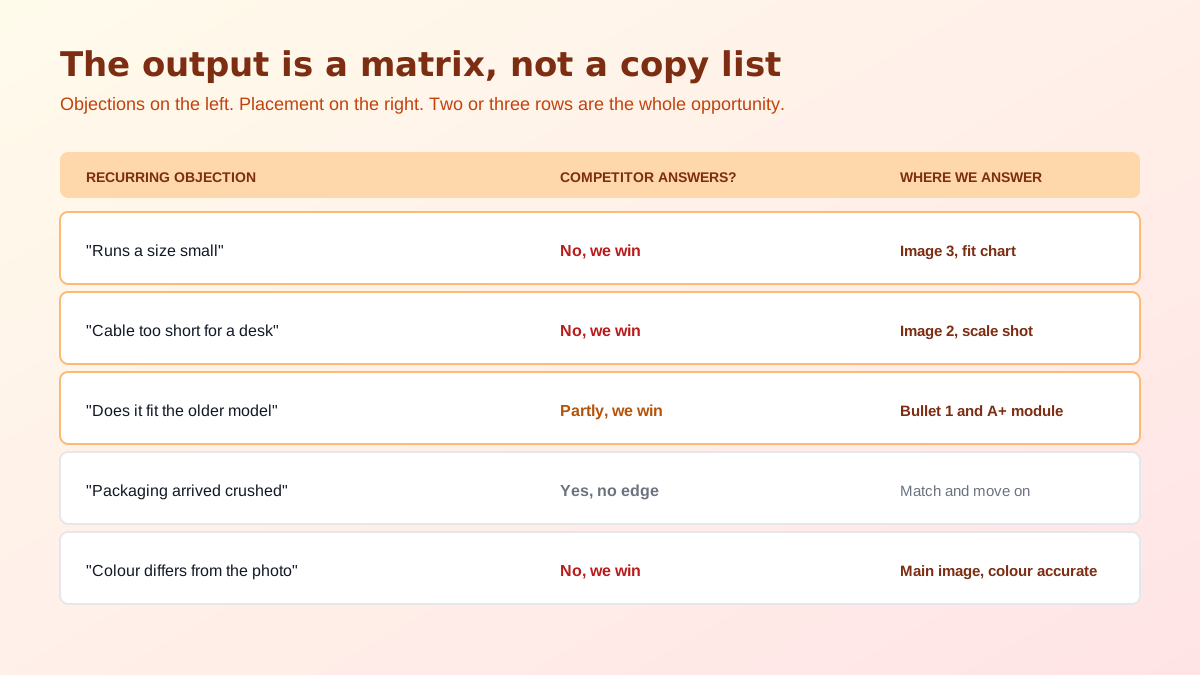
The output of an amazon competitor listing analysis should not be a list of things to copy. It should be a table of objections, one row each, with three columns: does the competitor answer this, do we have a genuine advantage here, and where would we answer it. That last column forces a decision about placement, which is where most of the value is, because an objection answered in bullet five is answered nowhere.
Rows where the competitor answers well and you have no advantage are rows you match and move on from. Rows where they answer nothing and you have a real advantage are the entire point of the exercise, and there are usually two or three of them. Those become your second and third images, your first bullet, and the opening module of your A+ content. Everything else is housekeeping.
Housekeeping still matters, and it is worth doing in the same pass since you have the page open. Title term order, bullet length, image count, whether you have a video at all, whether your variation family is intact. Those are hygiene items with known answers rather than competitive insights, and the Amazon listing optimization playbook covers the whole set in the order they are worth fixing.
A single snapshot shows you a page. A series shows you decisions and their consequences, which is the only way to learn anything causal from outside a business. When a competitor swaps their main image and moves up two positions over the following fortnight, you have learned something worth acting on. When you observe the same page once and infer that its bullet style is why it ranks, you have learned nothing and are about to spend a week acting on it. Treating amazon competitor listing analysis as a running log rather than a one off audit is the difference between the two outcomes, and the running version costs about ten minutes a month once the sheet exists.
The place this most often pays off is imagery, because it is the highest leverage element and the one competitors change least often. If every listing on the term uses the same tired white background hero and none of them show scale, that gap is available to whoever fills it first. Images carry more of the buying decision than the copy does, and the product image conversion statistics give a sense of how much. Producing the extra frames used to be the constraint, which is less true now that a full sequence can be generated from one clean shot with AI product photography rather than booked as a studio day.
One caveat before you start rewriting anything. If your listing is not indexed for the terms you are comparing on, none of this analysis applies yet, because you are not in the same race. Check indexing first, since a page can carry a term in its bullets and still not be retrievable for it, a failure mode the piece on Amazon bullet points disappeared touches on from a different direction.
Everything on the front of the page: title wording and order, bullet sequence, image order, A+ modules, video, price, badges, variation family size, rating, review count, category rank and date first available. What you cannot see is their advertising spend, conversion rate, margin or backend search terms, which is exactly the set of things that most often explains their position.
Copy the vocabulary, not the structure. The nouns and qualifiers that appear across several ranking listings tell you what buyers type, and that is useful. The structure of a listing with four thousand reviews is being carried by those reviews, so reproducing its word order transfers none of what is actually holding it up.
The ones ranking for the specific search terms you want, not the category bestsellers. A category leader often ranks on brand demand that has nothing to do with the term you are chasing. Run your three priority terms, take the listings in the top positions for each, and treat that as the comparison set.
Because they name the objections in the buyer's own words, and those objections are usually unanswered on the competitor's page. Sizing that runs small, a cable that is too short, a part that does not fit a common model: if your product does not have that flaw and your listing says so in the images and bullets, you have found real differentiation rather than a cosmetic one.
It gives you the age of the listing, which is the cheapest way to sanity check a review count. A listing with two thousand reviews built over six years is a different competitor from one with eight hundred built in nine months. The second is growing, the first may simply be old, and you would attack them differently.
A full pass each quarter is usually enough, with a lighter check whenever your own rank moves. What matters more than frequency is keeping the previous snapshot, because a change to a competitor's main image or bullet order followed by a rank move tells you far more than any single observation of the page ever will.
ListingRVA AI now works inside Claude. Connect your workspace and ask Claude to generate listing copy and publish product images to your store, without leaving your editor. See the Claude connector →
Comments
No comments yet, be the first.
Leave a comment