
Amazon Listing Optimization Timeline: How Long Before Rank Moves
August 17, 2026 · 8 min read · by Aashirvad Kumar
Your credits refresh every month for as long as ListingRVA AI exists. No renewals, no annual increases, nothing to cancel.
Available on select plans. No renewals, ever.
August 17, 2026 · 8 min read · by Aashirvad Kumar
You rewrote the title, replaced all five bullets, filled the backend search term field properly and pushed a better main image. Two days later the rank report looks identical, and one keyword has actually slipped a few places. Nothing happened. The amazon listing optimization timeline is considerably longer than the patience most sellers bring to it, and the clock does not start when you press save.
What happens next is almost always one of two reactions, and both are worse than sitting still. Some sellers revert, throwing away a change that may well have been correct and stacking a second unmeasured edit on top of the first. Others edit again the following week, and then again, until four changes are in flight at once and no future data set can ever attribute a movement to any of them. Understanding the sequence is what stops both.
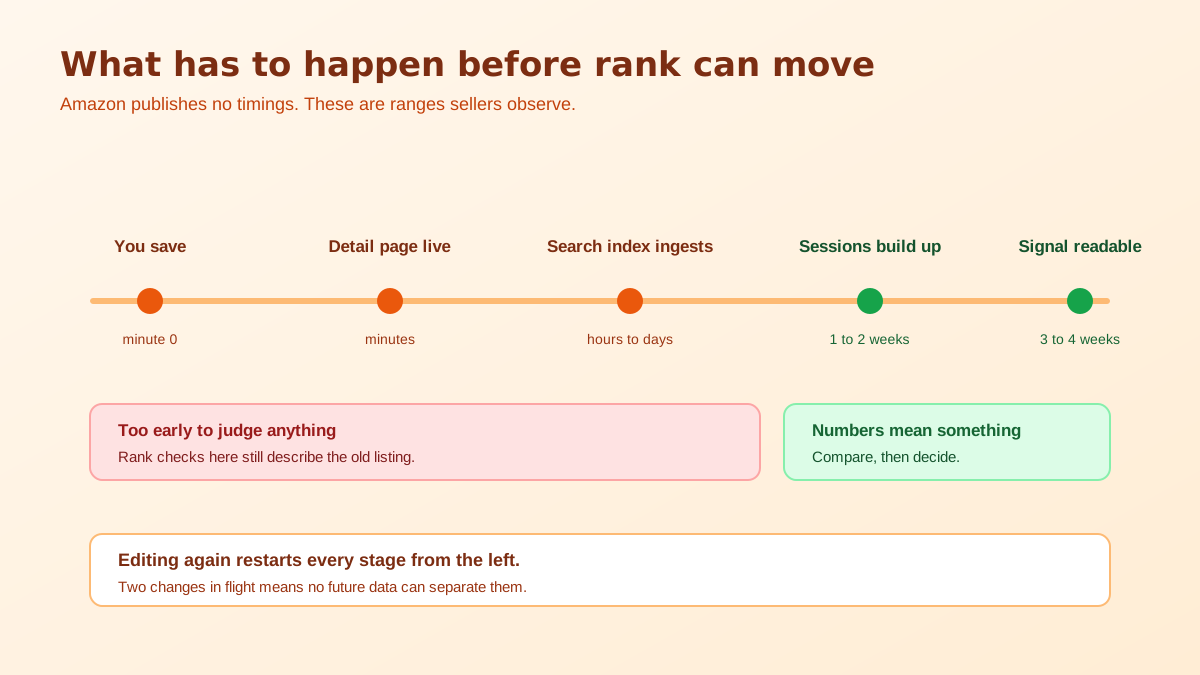
Saving in Seller Central updates the detail page and the search index on two different schedules. The customer-facing page is rendered from the catalogue record and typically refreshes within minutes, which is why you can reload your own listing and see the new copy immediately. Search results are served from a separate index that has to ingest the changed fields, and Amazon does not publish how long ingestion takes or commit to a window for it. What sellers consistently observe is a lag measured in hours to a few days rather than minutes, and a longer one when the change touches a large variation family.
That gap sets the earliest moment the amazon listing optimization timeline can even begin. Checking your position for a new phrase on day one is not an early read on the new listing, it is a measurement of the old one. A term that appears to have gone nowhere may simply be sitting in a queue, and a term that appears to have vanished may be mid-refresh. Neither result carries information, which is exactly why acting on either one is how sellers end up with three overlapping edits.
You can test ingestion instead of guessing at it. Type the exact phrase you added into the Amazon search bar together with the ASIN, and if the listing comes back then that phrase is in the index for that product. If nothing comes back, repeat the check a day or two later before drawing a conclusion, because a first negative usually means too early rather than rejected. Backend fields deserve this check more than anything else, since terms build best from language buyers actually type, which is the job a free Amazon keyword generator exists to do.
Indexation is a prerequisite, not a result. A listing can be perfectly indexed for a phrase and sit on page nine of it, because the ranking system has no performance history for that product against that query yet. Being findable and being ranked are separate states, separated by weeks of accumulated behaviour, and confusing the two is behind most premature verdicts on a rewrite. The mechanics of that gap are the whole subject of being indexed but not ranking.
Organic position on Amazon leans heavily on recent sales performance against a specific query, not on lifetime totals. That means the system is reading a rolling recent window, with older orders counting for progressively less. Amazon has never published the length of that window, and anyone quoting an exact number of days is guessing. What matters practically is only that the window is long enough that a single day tells you nothing, and that after an edit the window still contains mostly pre-edit behaviour for a while.
Do the arithmetic on your own product and the problem becomes obvious. A listing taking four orders a day produces eight orders in the 48 hours most sellers wait before panicking. Eight orders is well inside the range that normal day-to-day variance moves anyway, so any comparison built on it is measuring weather, not the change. The lower your unit volume, the longer you must wait, which is the reverse of what small sellers assume when they iterate faster because they feel behind.
Conversion rate is worse still, because it is a ratio and a ratio computed on a small denominator is almost entirely noise. Forty sessions and two orders reads as five percent. One extra order, from one shopper who would have bought regardless, reads as seven and a half. Nothing about the listing changed between those two numbers. You need a few hundred sessions on the affected listing before a conversion difference is worth reading at all, and on a slow ASIN that alone can take a month.
Image changes are the one case where a faster signal exists, because a new main image alters click-through rate before it alters anything downstream. Impressions accumulate far quicker than orders, so a hero image can be assessed on click behaviour within days even when its conversion effect is still unreadable. That only holds if the image is compliant and rendering properly at thumbnail size in the first place, which is the ground covered by the Amazon image requirements guide.
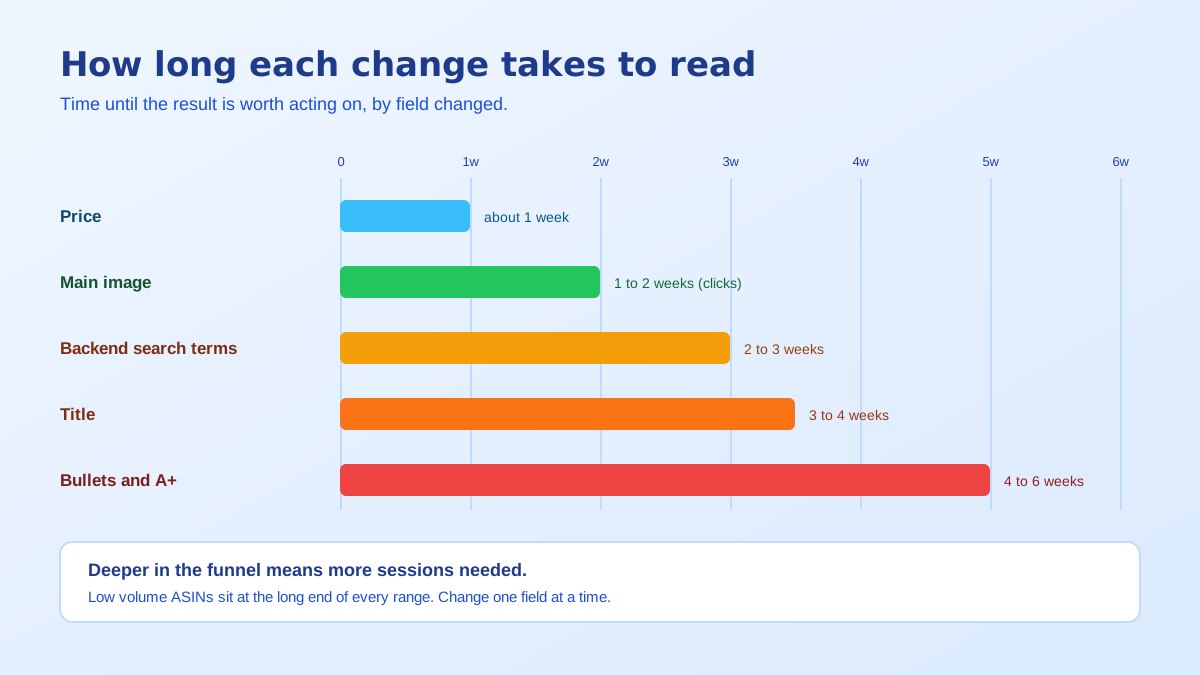
Different fields report back on different schedules, because they act on different parts of the funnel. A backend term changes which queries you are eligible for. A title changes eligibility and click-through together. Bullets and A+ act only after the click, on people who are already on the page. Price acts instantly on everyone. Ranges below are what sellers commonly observe, not published Amazon figures, and every one of them stretches on a low-traffic ASIN.
The practical consequence of that table is a rule most sellers already know and ignore: one change per measurement period. Changing the title and the main image in the same session produces a single combined result you cannot decompose afterwards, and the temptation is strong precisely because both feel overdue. If a listing genuinely needs several fixes, sequence them by the speed at which they report back rather than by how much they bother you, and write the date of each one down somewhere you will still have it in a month.
Before calling any optimization a failure, four questions have to come back clean. Was the change confirmed in the index, by the ASIN plus phrase check rather than by assumption. Has the listing accumulated enough sessions since that confirmation for a ratio to mean anything. Did anything else move in the same period, including price, a competitor's price, stock availability, review count, ad spend or the season. And are you comparing against a period of the same length rather than against a good week you remember.
A genuine failure looks specific. Indexation is confirmed, several hundred sessions have accumulated, conversion rate is flat or down against a comparable window, and there is no confounder you can name. That is a result worth acting on. Everything else, and it is most of what gets called a failed optimization, is a change that has not finished being measured. Treating the second case like the first is what converts a neutral edit into a genuinely damaged listing, because each new edit resets the clock you were already halfway through.
One category is exempt from all of this waiting, and it is worth separating out clearly. Objectively broken things are not experiments. A title truncating on mobile, a missing search term field, an image that fails a marketplace specification, a bullet that violates a category rule: none of those need a measurement window, because there is no hypothesis being tested. Fix them the day you find them, and if you are unsure which of your problems are defects rather than opinions, an Amazon listing quality checker sorts one from the other quickly.
Waiting does not mean staring at a rank tracker. The most useful thing you can do inside the window is compress it, and the honest way to compress it is to buy the sessions you are short of. Running ads on the exact terms you changed pushes traffic through the new listing far faster than organic discovery will, which gets the denominator of your conversion calculation to a usable size in days rather than weeks. The organic read afterwards is cleaner, provided ad spend stays constant across the comparison.
The second thing is record keeping, and it is the part almost nobody does. A single sheet with the date, the field changed, the exact old text and the exact new text turns your amazon listing optimization timeline into something you can audit later instead of reconstructing from memory. It also makes reverting a precise operation rather than a guess. Building the replacement copy against a repeatable structure helps here too, which is the argument for working from a defined Amazon listing optimization workflow rather than rewriting by instinct each time.
Finally, use the wait to prepare the next change rather than to make it. Draft the alternative title, generate the alternative hero image, and leave both sitting ready. When the current measurement period closes you will have a decision to make on real numbers and an asset already built to act on it, which is a much better position than the one that produces weekly edits. A tested structure for the title itself is easy to prototype with an Amazon title generator tool while you wait for the current version to report back.
Longer than the two or three days most sellers give it. The changed fields have to be picked up into the search index first, which sellers commonly observe taking a few hours to a few days rather than minutes, and then the listing has to accumulate enough clicks and orders for the ranking system to have anything to read. On a product selling a handful of units a day, that second stage is measured in weeks. Amazon does not publish either figure.
There is no evidence Amazon wipes a product's history because you edited a field, and normal edits do not send an established listing back to zero. What genuinely does happen is that the relevance side of the calculation changes while the performance side stays attached to the old wording, so positions can wobble for a while. The wobble is not a penalty, it is the system recalculating with new inputs.
Search the exact phrase together with the ASIN in the Amazon search bar. If your listing is the result, that phrase is in the index for that product. If nothing comes back, either the change has not been ingested yet or the term was never accepted, and the way to tell them apart is to repeat the same check a day or two later before concluding anything.
Only if you are willing to give up knowing which one did the work. A title change moves which queries you appear for, a main image change moves how many people click once you appear, and both feed the same session and order numbers. Changed together they produce one combined result you cannot decompose. If you have the traffic to test properly, separate them by at least three weeks.
Do not revert on the basis of a flat week, because a flat week is the expected appearance of a change that has not been measured yet. Wait until you have confirmed indexation, accumulated a few hundred sessions on the affected listing, and compared conversion rate against a period of similar length. Revert only if the numbers are worse on that comparison and you can rule out price, stock and seasonality.
Usually because you dropped terms. If a phrase that was carrying sales existed only in the old title or the old backend field and the rewrite removed it, relevance for that query goes with it, and no amount of waiting brings it back. Before any rewrite, record which search terms currently produce orders and confirm every one of them survives into the new copy.
ListingRVA AI now works inside Claude. Connect your workspace and ask Claude to generate listing copy and publish product images to your store, without leaving your editor. See the Claude connector →
Comments
No comments yet, be the first.
Leave a comment